Jax Says
Live translation in your ears: Google brings real-time translate to iOS and it’s free !
Google announced that Live translate with headphones is now arriving on iOS, works with any pair of headphones, supports 70+ languages, and is expanding...
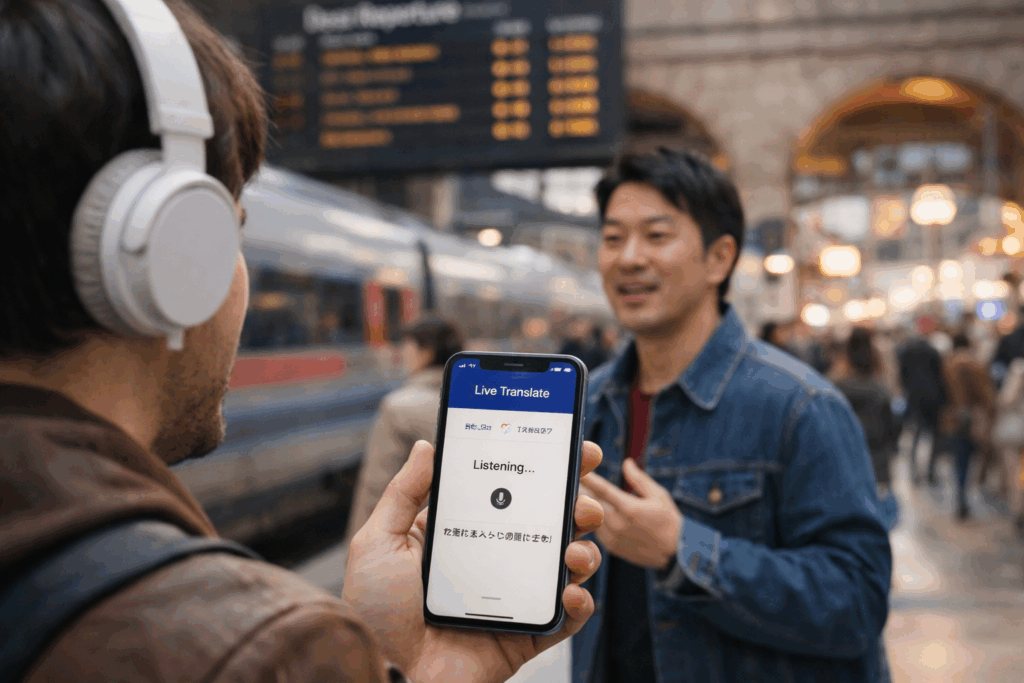
Google announced that Live translate with headphones is now arriving on iOS, works with any pair of headphones, supports 70+ languages, and is expanding to more countries including France, Germany, Italy, Japan, Spain, Thailand, and the U.K. Google says users can open the Translate app, tap “Live translate,” and connect headphones to start using it.
Your headphones just became a live translator
For years, real-time translation felt like one of those ideas that always sounded close, but never quite ready.
Now it is getting a lot more real.
Google is bringing Live translate with headphones to iPhone, which means your headphones can help you follow conversations, catch announcements, and understand what is being said around you in another language, in real time. It is a simple shift, but it changes a lot.
Why this matters
Most translation tools have been useful, but awkward.
You stop the conversation.
You hand over a phone.
You wait for the app to catch up.
You lose the flow.
This update moves translation closer to where people actually need it: inside real life.
You are in a train station abroad.
You are at dinner with family members who speak another language.
You are trying to understand a recommendation from a local shop owner.
You are listening, responding, and staying present instead of managing a tool.
That is the real change here. It is less about translating words and more about reducing friction between people.
What Google is launching
Google says the feature now works on iOS, after previously being available on Android in limited markets. It also says the feature supports more than 70 languages and can be used through any headphones, not only a specific hardware model. Google also highlights that the system aims to preserve more of the speaker’s tone and cadence, which matters because meaning is often carried by how something is said, not only by the words themselves.
To use it, Google says you open the Translate app, tap Live translate, and connect your headphones.
The bigger point
This is where AI gets interesting.
Not when it writes another generic paragraph.
Not when it adds one more feature to a crowded app.
When it quietly removes a real problem.
Language is still one of the biggest everyday barriers in travel, work, and family life. If a tool can reduce that barrier without asking people to change their habits, that is when adoption starts to make sense.
That is also why this launch stands out.
It does not ask users to learn a new system. It fits into something they already do: wear headphones, open an app, listen, respond.
Good product design often looks obvious in hindsight.
Where this could have real impact
1. Travel
This is the most obvious case, and maybe the strongest.
Train announcements, hotel check-ins, restaurant questions, quick chats with locals. Small moments become easier.
2. Family and relationships
Google’s own example focuses on family conversation, and that rings true. Multilingual families often live with tiny gaps in understanding. A tool like this can make people feel more included in the moment.
3. Everyday learning
Even if you are not travelling, this can help people spend more time around a language without feeling lost. That lowers the barrier to practice.
4. Business
International meetings, events, trade shows, field visits, customer conversations. It will not replace human interpreters in high-stakes settings, but it could make many informal interactions smoother and faster.
What still matters
This is promising, but it is not magic.
Real-world audio is messy. People interrupt each other. Background noise matters. Context matters. Accents matter. In business or legal settings, precision still matters more than convenience.
So the smart view is this:
Use it to improve access and speed.
Do not assume it replaces judgment.
That is the difference between a useful AI tool and an overhyped one.
Final thought
The best AI products do not feel like AI products.
They feel like something that should have existed already.
Turning ordinary headphones into a live translator gets very close to that line. And if the experience works as smoothly as Google suggests, this could become one of the clearest examples of AI creating value in an everyday moment people instantly understand.
Not flashy.
Not abstract.
Just useful.
See other posts

Waiting Is an AI Decision Too
Why practical, hands-on AI coaching helps teams start safely and create measurable value I have a...

Merger & Acquisition Project
A nice 4 months project ended this june.Mission : Find Accountancy Offices and Fiduciaries that are...

AI: A Major Asset for Small Businesses—Why Act Now?
Artificial Intelligence (AI) has become a buzzword in news articles, professional networks, and workplace discussions. Chances...