Business use · 7 Nov 2026 · 17:41 CET
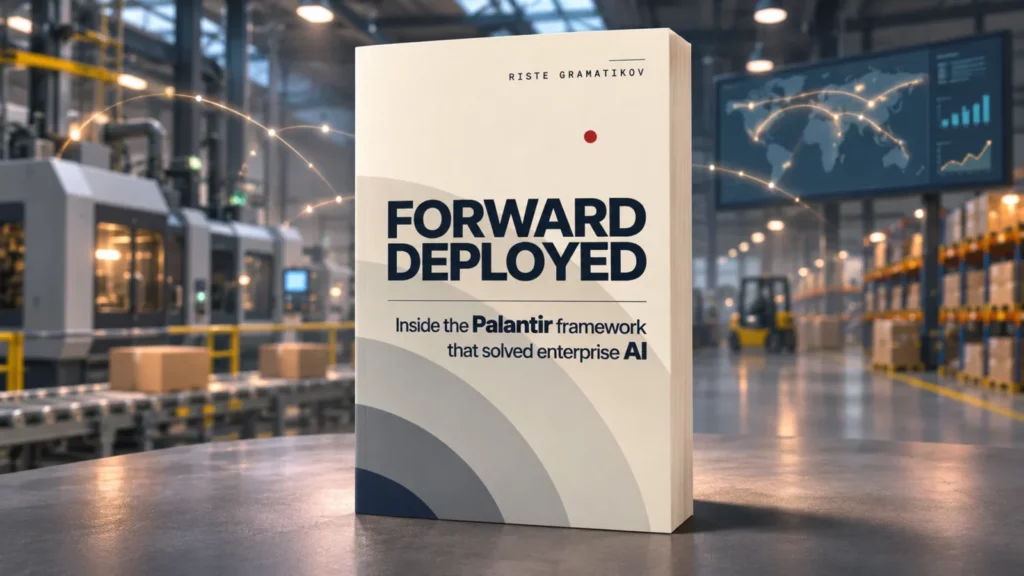
Book Review: Forward Deployed: Inside the Palantir Framework That Solved Enterprise AI by Riste Gramatikov
Publisher preview · OZZZER analysis pending editorial review.
PUBLISHER ARTICLE PREVIEW
From the original article
Ever since The Lean Startup by Eric Ries was published in 2011, prevailing wisdom in the SaaS community has been to launch a minimum viable product (MVP) rather than wait for a perfect, feature-complete release. The lesson was to release quickly, gather real user feedback, and continuously improve through small, iterative updates instead of relying on assumptions.
Another foundational SaaS principle is “Validate Before You Scale.” The assumption is that you shouldn’t invest heavily in building a complete software product before proving that customers actually want it. Launch the MVP, validate demand with real users, and expand functionality based on demonstrated needs.
Another principle closely associated with Paul Graham and the early philosophy of Y Combinator is to build something a small number of people love rather than something a large number of people merely like. In theory, this allows a product to scale as more users discover that they cannot operate without the software being offered.
The thing is, Palantir challenges the conventional way these rules are applied. The book Forward Deployed: Inside the Palantir Framework That Solved Enterprise AI by Riste Gramatikov reveals how this is done. It is less about abandoning customer feedback than taking it much further, embedding engineers inside the businesses whose problems they are trying to solve.
Palantir approaches its business through first-principles thinking. This extends from its internal workings to its Forward Deployed Engineer (FDE) model, which embeds software engineers directly with customers to understand their problems firsthand, develop tailored solutions, and continuously refine the software based on real-world usage.
Rather than separating developers from end users, Palantir creates a direct feedback loop between engineering and customers. This allows the company to solve immediate problems while incorporating lessons learned into its core platform, making the software increasingly valuable and scalable across its customer base.
Traditional SaaS principles would suggest that this could not scale properly, as each business has unique requirements.
Source
Unite.AI · 7 Nov 2026 · 17:41 CET
Open the original at Unite.AI ↗