Models & tools · 27 Oct 2026 · 17:50 CET
Exowatt beats frontier models on accuracy with SageMaker serverless model customization
Publisher preview · OZZZER analysis pending editorial review.
PUBLISHER ARTICLE PREVIEW
From the original article
Exowatt builds modular, dispatchable solar systems that deliver reliable power for energy-intensive applications such as AI data centers. Its flagship product, the Exowatt P3, captures solar energy through optical lenses, stores it as heat in a long-duration thermal battery, and dispatches electricity on demand through a heat engine. Unlike grid-tied photovoltaic solar systems, P3 powers data centers directly behind the meter, helping data centers come online without waiting in multi-year grid interconnection queues.
Exowatt builds a fleet of AI agents that monitor and triage live alarms and support operational decisions for solar systems, often at the edge, with limited or no connectivity. As its fleet scales from test benches toward manufacturing and thousands of deployed field units, the intelligence layer that operates these systems must scale with it.
In this post, we show how Exowatt used Amazon SageMaker AI serverless model customization to build a repeatable AI pipeline. The pipeline produces task-specific fine-tuned models for two deployment targets, edge and cloud, achieving higher accuracy than frontier models at up to 49× lower cost.
The two models described here are the first outputs of that pipeline rather than the end goal. The more durable result of the engagement was the pipeline itself: a repeatable path from raw operational data to a certified training set, a fine-tuned model, and an evaluated deployment artifact. Exowatt can now run this path in days rather than months.
Alarm triage and energy-market analysis are two of many narrow, high-value tasks where the same approach applies.
Exowatt’s energy management system (EMS) runs across a growing fleet of operational sites. Each site continuously produces alarms: a hardware component operating out of spec, a dropped connection, an out-of-range voltage reading, and similar events. As the fleet scales toward thousands of field units, a human operator can’t monitor every site in real time.
Exowatt needed an AI agent that could read the alarm state on each site and take or recommend the correct next action autonomously and reliably.
This is where Exowatt turned to model customization. Exowatt’s initial fine-tuning workflow relied on selecting an open-weight model, building a container, and creating a custom training recipe before any experiment could run. This was a major blocker for model experimentation. Additionally, they had to decide GPU hardware requirements of model fine-tuning. As the team increased the pace of experimentation, each run first required choosing a specific GPU instance type and then waiting for that self-selected capacity to become available.
When a chosen instance type was unavailable, this could delay the start of a run or block it entirely.
They needed a model small enough to run on a no-GPU edge controller, yet accurate enough compared to the frontier model on the specific task to act autonomously. Fine-tuning closed that gap: a compact, task-specialized model that is both deployable in the cloud and at the edge.
Exowatt addressed these challenges by adopting a cloud-native, serverless model customization approach on Amazon SageMaker AI. The same training pipeline produces fine-tuned models for two deployment targets: the edge and the cloud.
Exowatt implemented this approach on the Qwen3-1.7B model for the first use case, edge alarm triage, then applied the same approach to the Qwen3-14B model for the second use case, cloud energy-market analysis. The company plans to reuse this solution to build smaller, task-specific models across the fleet.
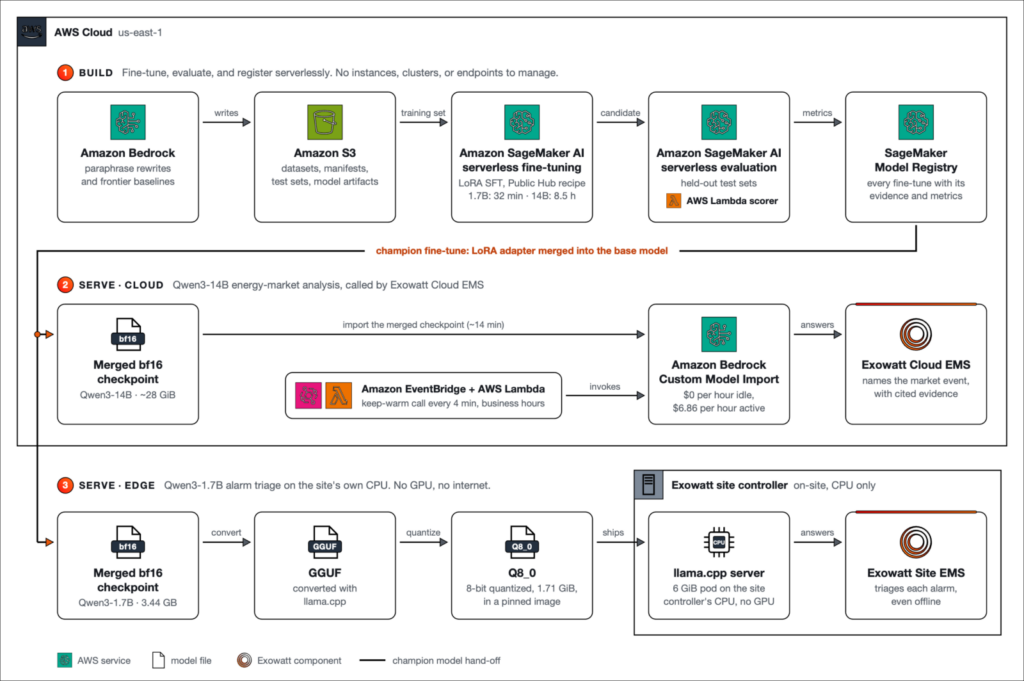
The following seven AWS services power the AI pipeline, with no instances, clusters, or endpoints to manage:…
Paraphrase (three rewrites per answer in the training data) and frontier model benchmarking…
Alarm-triage paraphrases use Qwen3-VL-235B on Amazon Bedrock. Energy-market paraphrases use Claude Sonnet 4.6 on Amazon Bedrock.
Model customization (cloud): Exowatt fine-tunes open-weight base models using serverless model customization, Low-Rank Adaptation (LoRA) and supervised fine-tuning (SFT) on SageMaker AI. Because serverless training allocates capacity on demand, the team runs multiple experiments per day rather than waiting for self-selected GPU. After evaluation, the best model is registered in the SageMaker AI Model Registry.
Edge deployment: For latency-sensitive, connectivity-constrained work such as alarm triage, the fine-tuned Qwen3-1.7B model is frozen, quantized to the GGUF format, and run with llama.cpp inside Kubernetes pods at the edge using on-site controllers.
Source
AWS AI · 27 Oct 2026 · 17:50 CET
Open the original at AWS AI ↗