Models & tools · 20 Oct 2026 · 15:00 CEST
Eka is worth $1.45B thanks to a physical AI model that has experts raving
Publisher preview · OZZZER analysis pending editorial review.
PUBLISHER ARTICLE PREVIEW
From the original article
Robots still aren’t that good at picking things up, despite billions of dollars of investment and endless videos fed into deep learning models.
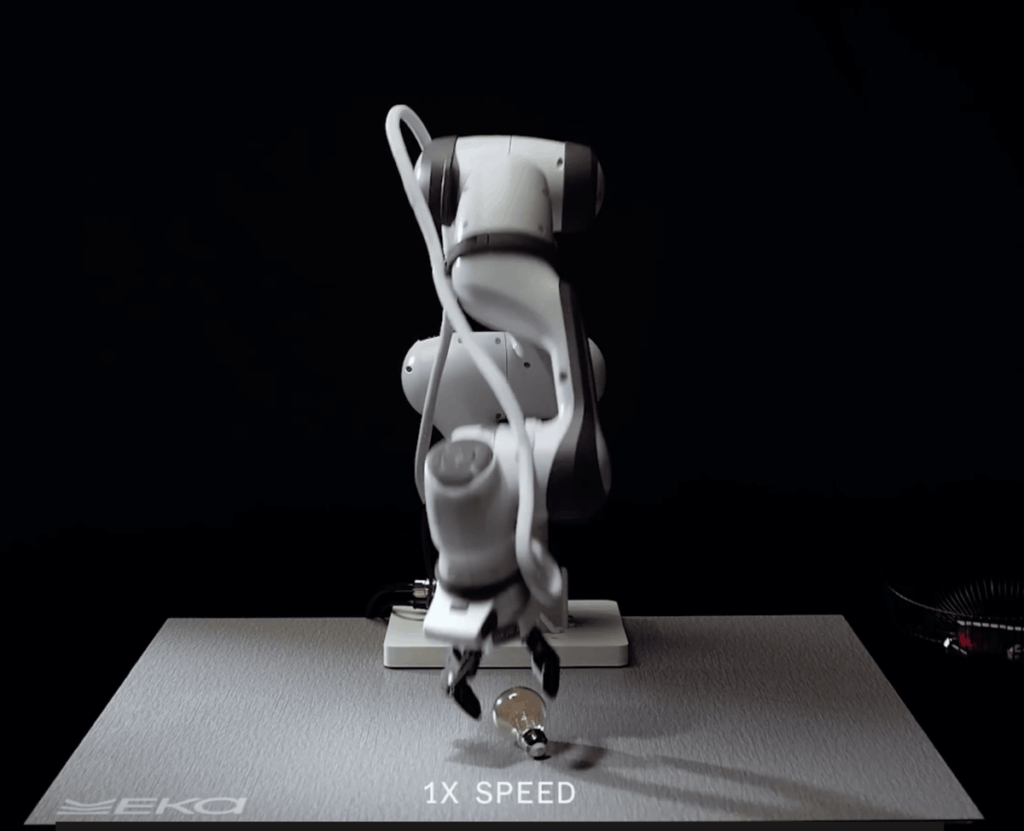
That may be about to change, thanks to a manipulation architecture built by Eka Robotics, which encompasses a force-sensitive gripper and a new kind of deep-learning model. Founded by MIT professor Pulkit Agrawal and former Google DeepMind researcher Tuomas Haarnoja, the startup just closed an $150 million Series A round that values it at $1.45 billion post-money, led by venture funds a16z and F-Prime.
“They are already exceeding superhuman performance for certain tasks, and so we think over the next few months there will be superhuman performance in many dexterous manipulation tasks,” Raghu Raguram, the a16z general partner who co-led the fundraising round, told TechCrunch.
In an era of never-ending robotic demonstrations, Eka’s capabilities are shocking veteran robot builders.
Kris Hauser, a professor at the University of Illinois Urbana-Champaign, said it had a “wow factor” compared to other robot demos he saw recently. The Eka robot “was able to adapt to a large number of different objects without retraining,” Hauser said, adding that it also had an aspect of “humanness, creepy humanness that it would try over and over again if it failed the first time.”
Another roboticist, who asked for anonymity because of their work at a frontier lab, told TechCrunch that seeing Eka’s robot in action was an emotional experience, comparable to when robots first achieved reliable legged locomotion five to ten years ago.
What’s notable here? How smoothly and rapidly the robot moves. It can pick up about 1,500 objects that weigh up to 1 kg in an hour, compared to about 600 for a human; Eka says it reliably picks up objects more than 95% of the time. And the robot arm is strong enough to hurt itself as it moves that quickly.
That indicates, per the frontier lab observer, that “they have a lot of trust in their algorithm not breaking the robot. I wonder how many robots they broke along the way?”
When the frontier lab roboticist met Eka’s robot, they handed it a raspberry, the lab’s apparent favorite test item.
Source
TechCrunch AI · 20 Oct 2026 · 15:00 CEST
Open the original at TechCrunch AI ↗