Models & tools · 6 Oct 2026 · 13:43 CEST
Researchers stretch LeCun's JEPA AI into a universal world model that works from physics to biology
Publisher preview · OZZZER analysis pending editorial review.
PUBLISHER ARTICLE PREVIEW
From the original article
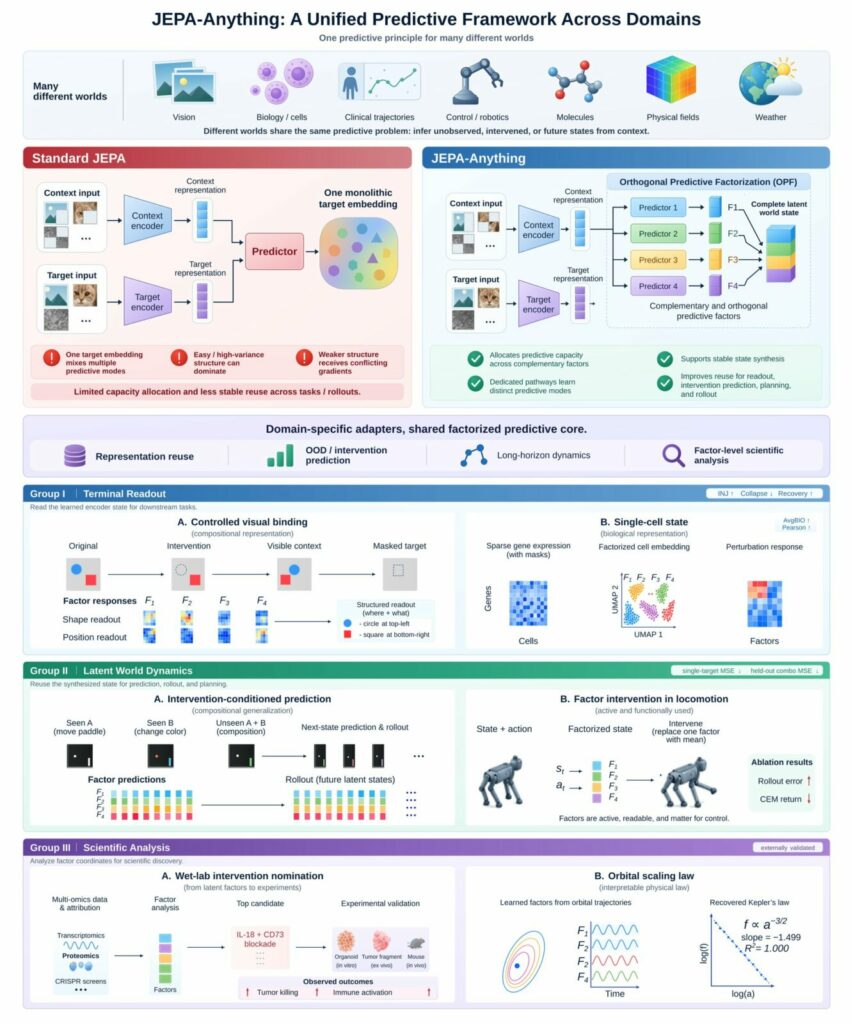
Researchers have expanded the JEPA architecture pioneered by Yann LeCun so it works across seven very different fields. The effort also produced a liver cancer treatment candidate that the team tested in the lab.
World models predict how a system will evolve, whether it's a robot, a molecule, or a patient's health. Until now, each domain has typically needed its own model. A team led by PhAI Labs, with collaborators from Stanford, Oxford, and Princeton, wants to show that a single shared principle is enough.
Their paper introduces JEPA-Anything, built on Joint-Embedding Predictive Architectures (JEPA). These models don't reconstruct raw data like pixels but instead predict an abstract summary of a missing or future state, filtering out irrelevant details. The authors see a weakness in the standard approach: everything gets funneled into a single prediction, so easy patterns end up drowning out harder ones.
JEPA-Anything breaks the predicted state into several parts, each handled by its own prediction module. An added constraint pushes the modules to capture different aspects rather than learning the same thing, and the model then reassembles their partial predictions into a complete picture.
The researchers don't assign meanings to the parts, letting those roles emerge during training. Instead, they only change how they prepare the data for each field.
The team compared JEPA-Anything against a standard JEPA with the same architecture, trained on the same data under identical conditions.
Source
THE DECODER · 6 Oct 2026 · 13:43 CEST
Open the original at THE DECODER ↗