Models & tools · 4 Oct 2026 · 12:10 CEST
NASA and IBM's open source lunar model turns 17 years of orbiter data into a foundation for lunar science
Publisher preview · OZZZER analysis pending editorial review.
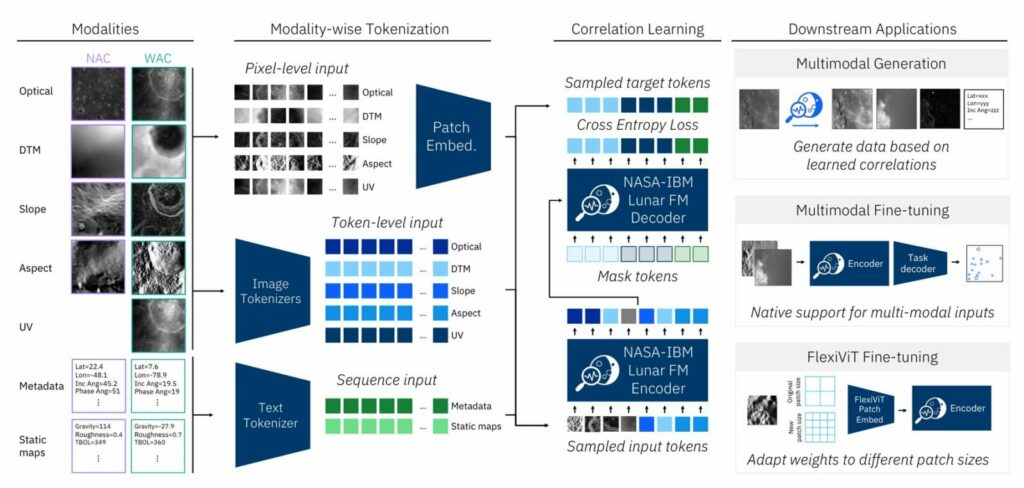
The NASA-IBM Lunar Foundation Model makes decades of lunar observation data usable for machine learning. It's especially strong at predicting ice deposits at the poles and detecting craters. "NASA has spent decades building an extraordinary scientific record of the Moon, but collecting data is only part of the job," says Kevin Murphy, NASA's chief science data officer.
The data also has to be easier for scientists to use, he adds. NASA and IBM Research, working with several academic institutions, have now released the NASA-IBM Lunar Foundation Model. The two organizations describe it as one of the first open-source foundation models for lunar science. Unlike task-specific algorithms, a foundation model is pretrained on large volumes of unlabeled data and can then be adapted to specific tasks with just a few labeled examples.
The team sees this as the main benefit for lunar research, where observation data is plentiful but labels are scarce. The team trained the model from scratch using SomBench, which they say is the largest co-registered multimodal lunar corpus to date. It contains nearly 2 million tile bundles across…
Excerpt supplied by the publisher.
Source
THE DECODER · 4 Oct 2026 · 12:10 CEST
Open the original at THE DECODER ↗