Jax Says
I Built an AI News Page. Now Let’s Talk About What We Could Build Next.
You can spend a whole day reading about AI and still finish with the same question: What can I actually do with all of...

You can spend a whole day reading about AI and still finish with the same question:
What can I actually do with all of this?
Another model. Another launch. Another promise that everything is about to change. Meanwhile, there is a client to help, a project to finish, and a problem you keep working around because fixing it feels complicated.
That gap is why I built my AI news page.
I wanted somewhere I could scan the news, filter it around my interests, and find ideas worth exploring. A one-stop shop that made the subject easier to follow.
So I built it with Codex.
I am not a developer. Yet here was a problem I understood, and I could shape a working tool around it. I wrote about that broader experience in AI tools for entrepreneurs.
The news page is another step in that adventure. And looking through its stories raises a question worth asking:
What problem do you understand well enough to start changing?
The useful story is often hiding inside the headline
The public archive contained 488 articles when we reviewed it on October 1.
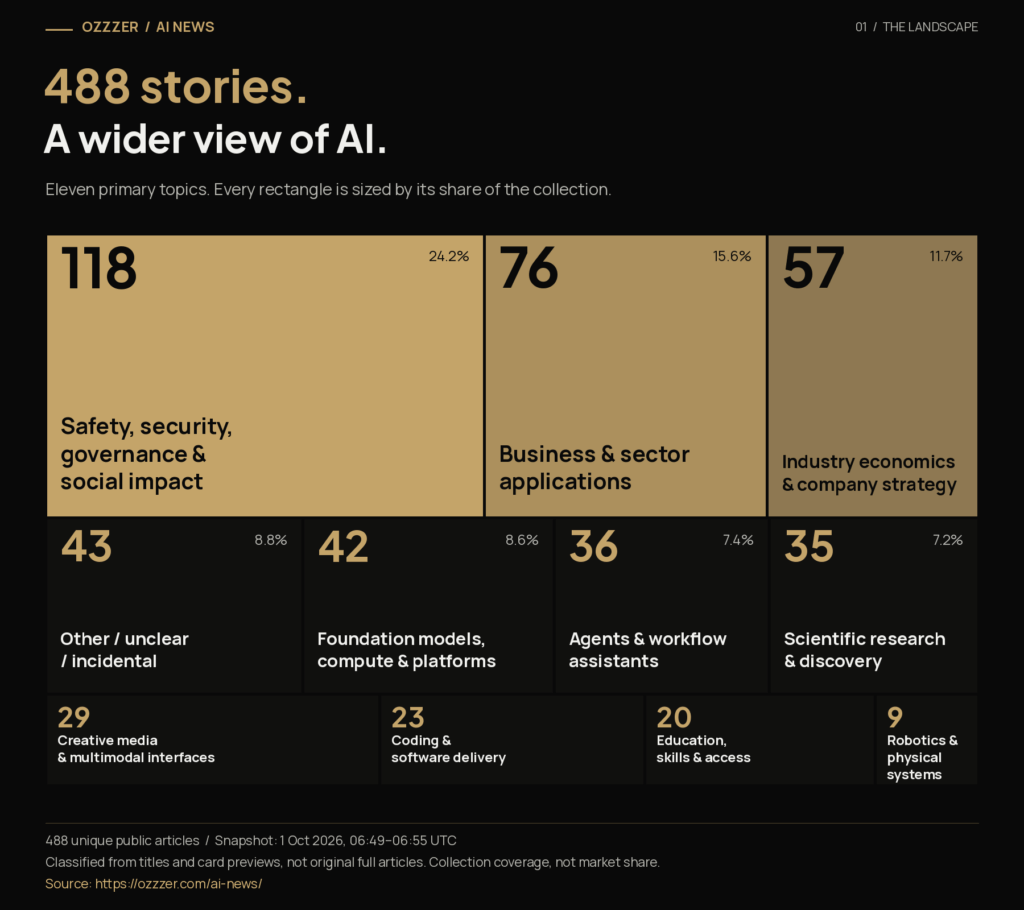
I wanted to understand what those stories could mean for everyday work.
Almost one in five entries was a practical guide or a deployment/customer case. Fewer than one in four covered a product, feature or platform release or update. The largest subject group concerned safety, security, governance and social impact.
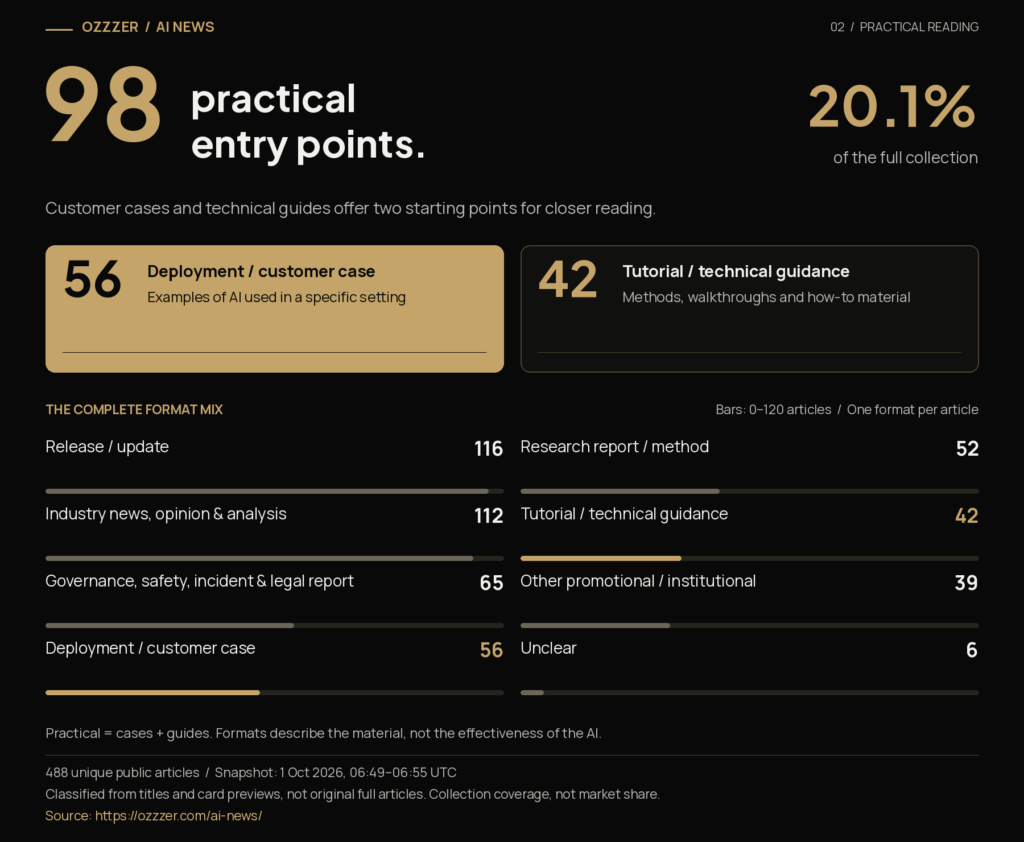
That gives us several ways to read the news: discover a capability, understand an implementation, or examine the questions that come with using it.
A video nobody can find. An idea that is difficult to explain. Old software that holds up improvements. An answer that looks convincing until someone asks where it came from.
These are good starting points because the problem already exists. You can describe it. You can test whether something improves it.
Your next useful resource might already be in your archive
Imagine having years of video on your drives and being able to ask for the moment you need in ordinary language.
Condé Nast’s video discovery project shows a version of that. Its work with AWS makes a large video library searchable through the content itself, including visuals, sound and transcripts.
The practical possibility is easy to picture. An old interview could help explain a new service. A forgotten demonstration could answer a customer’s question. Material you already own could become easier to use again.
Elsewhere, AWS describes an image-to-video workflow. A creative team can review a still image before moving on to animation. That creates a useful decision point in the production process.
Then there is Gemini’s task-directed video inspection: selecting relevant parts of a recording to examine according to the question being asked.
Together, these examples suggest an interesting direction. AI tools can help us find, understand and develop visual material through connected steps.
For a business, I would start with a real question. Could we find the right clip more easily? Could we test a visual idea before committing to production? Could we extract useful information from a long recording?
You would still need to check the results, protect private material and judge the creative quality. But now you have something specific to test.
An idea becomes easier to improve when someone can try it
There is a moment in many projects when everybody agrees with the explanation, but nobody can quite picture the same thing.
A working prototype can change that conversation.
In Proaction’s story, a nontechnical cofounder uses Codex to turn customer conversations into tailored demos. Customers can try a workflow shaped around their operation. Engineers still handle the production system.
A customer can point to a screen and explain what is missing. A team can discover a bad assumption while the idea is still easy to change.
That connects directly to what interests me about building with AI. Your knowledge of the work becomes something you can demonstrate, discuss and improve.
At a different scale, Asana used Codex for a code migration, with engineers reviewing proposed changes. Clear conventions and tests helped define what a good result looked like.
The practical lesson is to choose work with a clear finish line and a way to check it.
For a small business, the first experiment could be a simple intake form or a demo of a better follow-up process. Something manageable enough to test and concrete enough to learn from.
Trust deserves a place in the picture
The archive’s largest subject group concerned safety, security, governance and social impact. That is a useful reminder to include trust in the design from the beginning.
ProvenanceGuard research tackles a subtle problem: an AI answer can contain a fact found in the evidence while attaching it to the wrong source.
Think about a customer-service answer. A general policy and the conditions applying to one particular customer may be different. Mixing them can create a confident answer that does not fit the situation.
The research investigates ways to check the connection between a claim and its source. It also shows that verification has tradeoffs and limitations.
For everyday work, the questions are straightforward:
Can I trace this answer back to its source? Is that source current? Does it apply to this particular case? What happens when the system cannot verify something?
These questions become more important as an assistant gets access to more information and more tools.
The idea of tracing AI-generated material is reaching further too. SynthID Bio research explores watermarking AI-designed proteins and molecular structures. It is a proof of concept, with more work needed before practical adoption.
For most businesses, the immediate lesson is simpler: preserve the origin, permissions and editing history of the AI-generated material you use.
I am exploring that shift in my own work
On September 30, I discovered dot. My reaction: really cool.
One example was an approved dropdown change in a client’s spreadsheet. It was a small task, with a clear target and a result that could be checked.
dot also helped analyse the news archive and investigate a feed issue. The investigation gave us something concrete to examine; it did not establish that the problem had been fixed.
Those details matter. Useful progress can be modest, and knowing exactly what happened is part of trusting the work.
I am still learning where this kind of assistant helps most. I also want clear control over what it can change or share.
That makes the experience interesting to me: exploring what is possible while keeping the decisions that matter visible.
So where do we go from here?
My reading of these examples is that much of the practical opportunity lies in connecting capabilities into useful workflows.
Finding the right material. Turning an idea into something testable. Completing a defined task. Checking the result against the right evidence.
That is an interpretation of these examples, rather than a prediction about the entire industry. But it gives us a useful way to choose our next experiment.
You probably have a process in mind already.
Perhaps your team searches for the same information again and again. Perhaps a client needs to see an idea before they can explain what they want. Perhaps a small administrative step interrupts the work every day.
Choose a manageable part of it. Describe what goes in, what should come out, and how you will recognise a good result. Use sample data where you can. Keep someone responsible for checking the output.
Then build or test a small version.
My news page began with a problem I wanted to solve for myself. That is a starting point other people can use too.
Your experience gives you something important: you know what a useful result should look like.
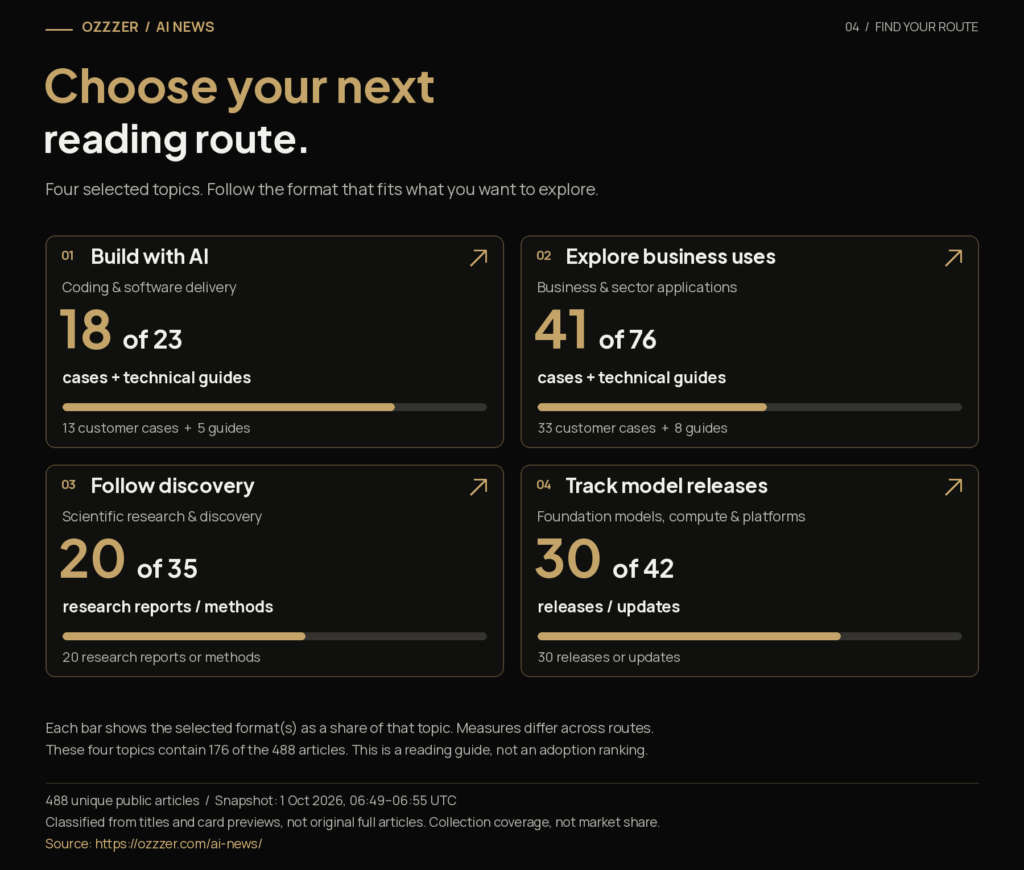
Explore, then choose something worth trying
Explore OZZZER AI News. You can read three stories without registering, then enter your email for full access. It remains free.
Use the filters to follow what interests you. Look for a story that connects to a problem you know. Follow its original source when you want to go deeper.
If you want help finding that connection in your business, tell me what you would like to improve.
Through Ozzzer and JackGPT, I help people turn their expertise into practical uses of AI, through coaching, better workflows and useful tools.
You do not need to have the whole future figured out to build something useful now.
About this review
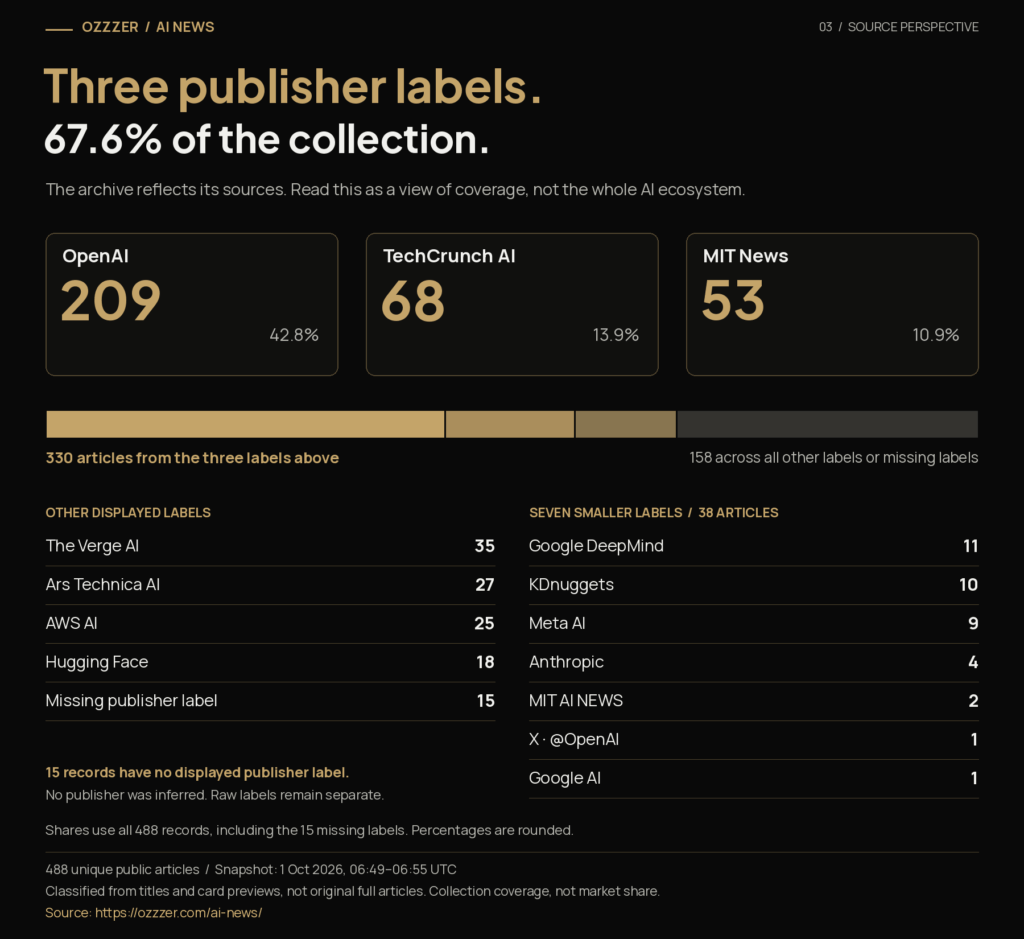
This analysis covers 488 public OZZZER article records captured on October 1, 2026, between 08:49 and 08:55 Brussels time. AI-assisted classification used titles and displayed previews, assigning one primary subject and content type per record. Selected examples were checked against original sources. The archive contains articles dated June 4 to October 1, with uneven source coverage; OpenAI supplies 42.8% of entries. These are article counts, not unique innovations or a representative industry survey. Customer cases report their publishers’ findings; practical extensions and conclusions are my interpretation.
See other posts
How AI Coaching Helps Professionals Solve Problems Faster, Even Outside Their Expertise
Let me tell you a secret: a year and a half ago, I had a heating...

The AI Capability Gap Starts With a Simple Question
Most companies are asking the wrong question about AI. They ask: Which tool should we buy?...

I Am Not A Developer, But I Am Building AI Tools I Used To Only Imagine
For years, I had ideas for tools I wanted to build. Not giant software platforms. Not...