AI · 25 Nov 2026 · 23:56 CET
Manage Liquid-Cooled AI Factories with NVIDIA Mission Control
Publisher preview · OZZZER analysis pending editorial review.
PUBLISHER ARTICLE PREVIEW
From the original article
Managing AI infrastructure such as NVIDIA Vera Rubin NVL72 requires coordinated operation of compute, power, and cooling systems. In liquid-cooled AI factories, a leak response may require operational teams to stop workloads, isolate affected nodes, and control power circuits and cooling valves.
AI factory operations span two domains that have historically operated separately. Information technology (IT) teams manage compute resources, workload orchestration, and application performance. Operational technology (OT) teams handle physical building systems—power distribution, cooling infrastructure, and environmental safety. This post explains how NVIDIA Mission Control connects IT and OT systems to coordinate leak responses and monitor compute and facility conditions.
Liquid cooling creates interdependencies between IT and OT systems that require coordinated responses. When a leak sensor triggers, IT systems may need to stop workloads and isolate affected compute nodes, while a building management system (BMS) manages power circuits and cooling valves. The response sequence depends on the configured policies and facility requirements. The challenge is coordinating these actions across systems quickly and reliably.
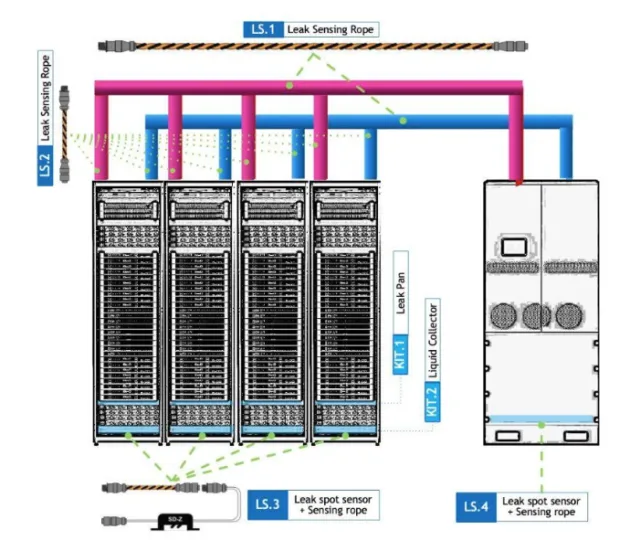
Figure 1 shows the leak detection components around the racks and coolant distribution unit.
Liquid-cooled systems can handle higher thermal loads per rack than air-cooled equivalents, supporting higher rack power densities.
Addressing these requirements helps when coordinating compliance activities, improving response times, and sharing operational data. Custom integrations that support real-time communication and actionable insights can be difficult to maintain as deployments grow.
When building liquid-cooled NVIDIA DGX SuperPOD clusters for production, the NVIDIA team tested tighter integration with building management systems by adding connections and policies to the cluster management software.
Source
NVIDIA · 25 Nov 2026 · 23:56 CET
Open the original at NVIDIA ↗