Automation & Agents · 6 Nov 2026 · 23:18 CET
OpenAI Introduces BioBasicsBench to Test AI Agents on Wet-Lab Data
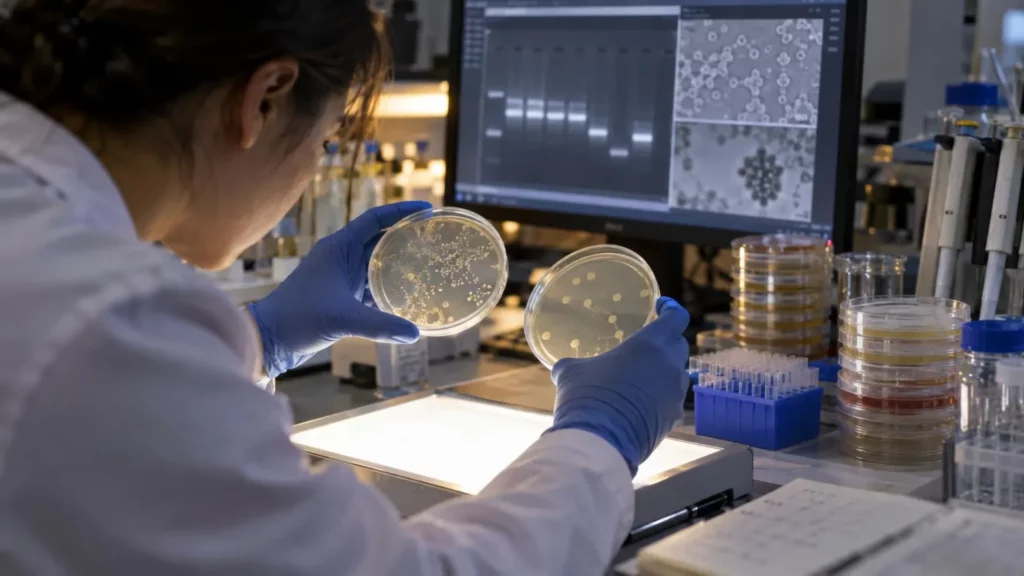
Publisher preview · OZZZER analysis pending editorial review.
OpenAI introduced BioBasicsBench on November 6, 2026, a 100-task benchmark developed with enzyme-design company Ligo to test whether AI agents can interpret raw evidence from routine wet-lab experiments. OpenAI reports results as mean reward, the average task score expressed as a percentage of available credit. At xhigh, the highest reasoning-effort setting reported for all seven models tested, GPT-6 Astra reached 66.7% with a 95% confidence interval of 60.3–73.1%, while GPT-5.6 Sol scored 43.8% with an interval of 37.6–50.0%.
Astra averaged 4,704 output tokens per task, compared with 9,099 for Sol. BioBasicsBench addresses a limitation OpenAI identifies in evaluations built around charts and images selected for scientific papers: everyday lab work also involves failed experiments, ambiguous images, conflicting observations and troubleshooting. Its tasks ask agents to interpret experimental data, spot errors and recognize when the evidence cannot justify a conclusion.
They span protein methods, imaging and cytometry, quantification and assays, nucleic acid methods and molecular cloning. Scientists created the tasks from their own experiments and wrote grading rubrics. Inputs include gel and blot images, colony plates, microscopy stacks, sequencing reads, plate-reader…
Excerpt supplied by the publisher.
Source
Unite.AI · 6 Nov 2026 · 23:18 CET
Open the original at Unite.AI ↗