Automation & Agents · 4 Nov 2026 · 17:33 CET
Smart Approvals in Amazon Quick: Human oversight where it matters
Publisher preview · OZZZER analysis pending editorial review.
PUBLISHER ARTICLE PREVIEW
From the original article
How should security leaders preserve human oversight as AI agents take on more work? Permissions establish which actions agents can take, but a permitted action can still warrant a person’s judgment. Requiring approval for every step might seem like the safest approach, yet multi-step tasks can produce repeated prompts, even for routine actions. Research on security warnings shows that attention and adherence can decline with repetition.
The challenge isn’t to require more approvals, but to preserve attention for decisions that need human review.
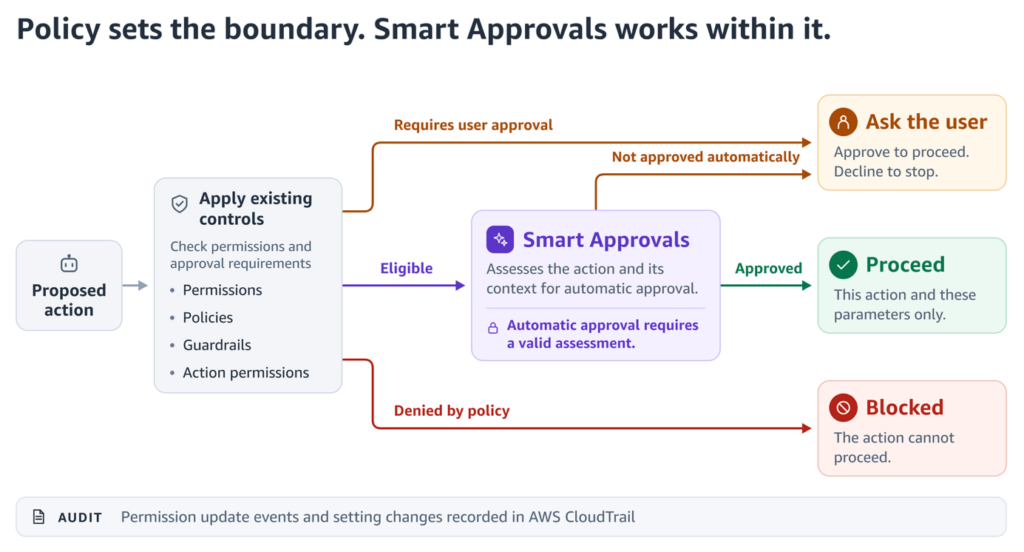
Smart Approvals in Amazon Quick addresses this challenge by reviewing eligible actions within your existing controls. It evaluates each proposed action against the user’s request and either approves it automatically or returns it to the user for review. It does this without granting additional permissions or removing required human approvals. Security leaders retain control over which actions must always go to a person, while Smart Approvals is designed to reduce unnecessary interruptions in routine work.
Quick evaluates each proposed action against Custom Permissions, Quick Guardrails, connector action permissions, and the user’s settings before automated review. Denied actions remain denied, and mandatory human approvals still apply. With Smart Approvals enabled, an action is eligible only when the user’s setting is “Ask each time” and no other control requires human approval.
Connector action permissions, configured when a connector is created, can require human approval for specific actions.
Administrators use Custom Permissions to determine who can use Smart Approvals. It’s on by default, but profiles with deny-by-default enabled must explicitly allow it. Users can also turn Smart Approvals off for themselves. That choice applies across conversations and scheduled runs. When it’s off, actions otherwise eligible for automated review require the user’s approval, and no account-level setting can turn it back on for them.
Smart Approvals uses a separate model, the classifier, to evaluate eligible actions against the user’s request and a bounded view of the conversation. It considers what the action does, where data goes, and who it affects.
Source
AWS AI · 4 Nov 2026 · 17:33 CET
Open the original at AWS AI ↗