Models & tools · 4 Nov 2026 · 19:46 CET
Use decision models with Amazon Bedrock AgentCore Evaluations
Publisher preview · OZZZER analysis pending editorial review.
PUBLISHER ARTICLE PREVIEW
From the original article
Some of the questions you ask when evaluating an agent are narrow and repeatable. Did this response stay on policy? Is this tool call safe to approve? Does this answer match the retrieved context? Decision models answer exactly that kind of question. They take a structured state and a fixed set of allowed answers and return a calibrated probability over them, rather than free-form text whose confidence drifts from run to run.
That makes them a strong fit for the scoring step in an agent evaluation, where you want a label and a number you can threshold and trust.
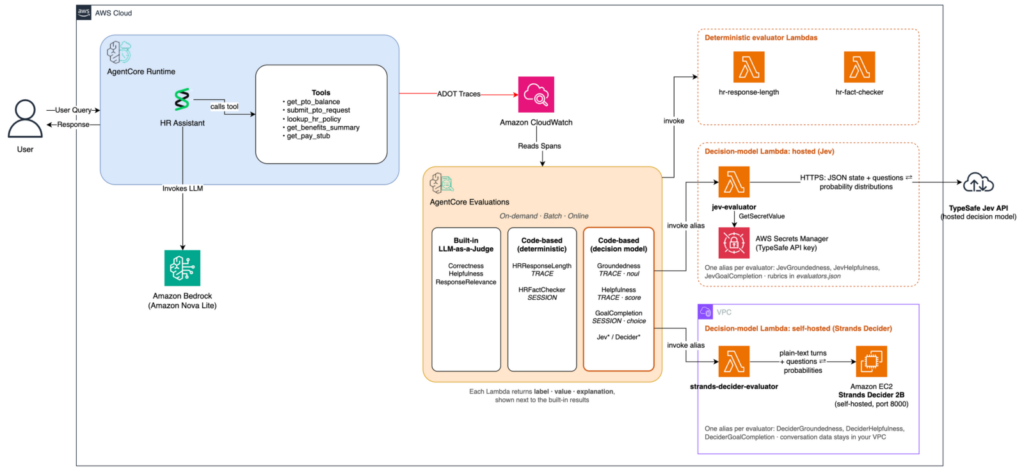
Amazon Bedrock AgentCore Evaluations, a capability of Amazon Bedrock AgentCore, scores an agent through its entire lifecycle, on demand during development, in batch jobs against stored sessions, and online against production traffic. Alongside 15 built-in evaluators, AgentCore Evaluations supports custom evaluators that you define as either an LLM-as-a-judge or a code-based evaluator. Custom LLM-as-a-judge evaluators apply your instructions and rating scale with a model in Amazon Bedrock.
Code-based evaluators run your own logic in an AWS Lambda function, and that logic can call your choice of external system, model, or API, including a decision model.
Decision models suit questions with a fixed set of answers that an informed person could decide at a glance, such as whether the agent refused a request or whether a response stayed on topic. After you validate a question on your own traffic, a decision model can be sufficient for that decision or score, and you can extend the same approach to specific harmfulness or stereotyping categories in your policy.
Because both backends can answer several questions about the same state in a single request, you can use them as a screening layer rather than a replacement, running a pass or fail signal across your metrics to select the turns that warrant deeper assessment by the built-in evaluators, whose explanations help you investigate what went wrong.
This post shows how to connect two decision model backends to AgentCore Evaluations through code-based evaluators. The first is Jev, a hosted decision model from TypeSafe. The second is Strands Decider 2B, an open-source decision model you run yourself. By the end of this post, you will know how to convert the AgentCore evaluator input into a decision model request, and the model’s probabilities back into an AgentCore evaluation result.
First, though, when should you reach for a custom LLM-as-a-judge evaluator, and when does a decision model fit better? The next section breaks down what a decision model is and the trade-offs involved.
A decision model is a small, specialized model trained to select from a fixed set of options and return calibrated confidence scores rather than generating free-form text. A general-purpose large language model (LLM) evaluator produces a score with a rationale. A decision model instead produces a probability distribution over predefined answers. That gives you a direct confidence measure you can threshold, aggregate, and act on programmatically.
This makes decision models well-suited for evaluation tasks where the judgment can be stated as a choice among a fixed set of options: “Is this response grounded?” or “Did the agent complete the user’s goal?”
Decision models are most useful when you want a well-calibrated confidence score alongside the label, not just a binary judgment. They are also appropriate when you want to enforce a specific rubric consistently without relying on a general-purpose LLM to interpret it.
Source
AWS AI · 4 Nov 2026 · 19:46 CET
Open the original at AWS AI ↗