Automation & Agents · 4 Nov 2026 · 23:00 CET
How NVIDIA Uses AI Agents to Streamline AI Factory Operations
Publisher preview · OZZZER analysis pending editorial review.
PUBLISHER ARTICLE PREVIEW
From the original article
As GPU clusters scale, operations span compute, network, hardware, and scheduling. Site reliability engineers (SREs) often have to examine multiple dashboards to identify the cause of training performance drops. What if a team of AI agents could perform that correlation through one interface?
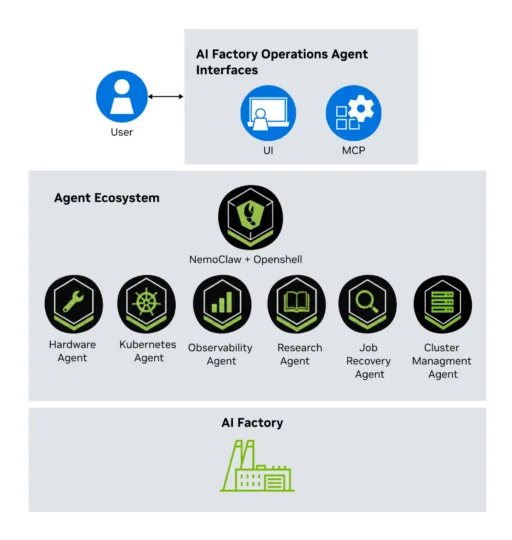
NVIDIA developed the AI Factory Operations Agent to streamline its own internal NVIDIA DGX SuperPOD operations and reduce the manual effort by NVIDIA SREs. Sub-agents communicate through Model Context Protocol (MCP) that any organization can adopt to maximize AI factory uptime and performance.
Instead of requiring SREs to check each layer of the AI factory software and hardware separately, the AI Factory Operations Agent uses specialized agents for different operational domains. In production, these agents detect failures, correlate root causes across layers, and surface clear recommendations through a chat interface. SREs can interact with any agent using natural language, switch between investigations, and track every action for auditability.
This blog will share learnings and teach you how to implement the AI Factory Operations Agent in your own workflow.
The AI Factory Operations Agent developer example was built around the NVIDIA NemoClaw blueprint. At the center sits the user-facing agent runtime, which receives SRE queries through a chat interface and invokes the appropriate domain agents and tools.
Agents connect to infrastructure through OpenClaw plugins and MCP servers, with each MCP exposing a focused set of approved operational tools. You can work through the built-in web UI or integrate existing coding-agent interfaces through the API. This modular design lets you add new agents and infrastructure integrations without changing the existing agents.
The framework is built using NVIDIA OpenShell and is fully on-premises capable, supporting extensibility and data sovereignty.
Source
NVIDIA · 4 Nov 2026 · 23:00 CET
Open the original at NVIDIA ↗