Automation & Agents · 4 Nov 2026 · 18:25 CET
Redis Broadens Iris With Agent Routing, Observability and Messaging
Publisher preview · OZZZER analysis pending editorial review.
PUBLISHER ARTICLE PREVIEW
From the original article
Redis announced on November 4, 2026 that its Iris real-time context engine now offers six composable capabilities for AI agents, with four generally available and two in beta. The expansion adds request routing, reusable procedures, observability and resilient messaging to a product previously centered on context and memory.
Customers can use the capabilities together, independently or in any combination within one runtime. Rowan Trollope’s rationale is that developers should not have to assemble separate infrastructure products to give agents memory, relevant context, live data access, routing and communication. Redis’s getting-started offer includes 5,000 free messages.
A companion technical deep dive by Simba Khadder, Redis’s director of software engineering, describes the production problems that design is meant to address: agents starting without prior history, retaining sensitive details while losing useful preferences, working with incomplete information and repeatedly rebuilding context for requests they have already handled. Those failure modes connect the release’s otherwise separate features around continuity, reuse and control.
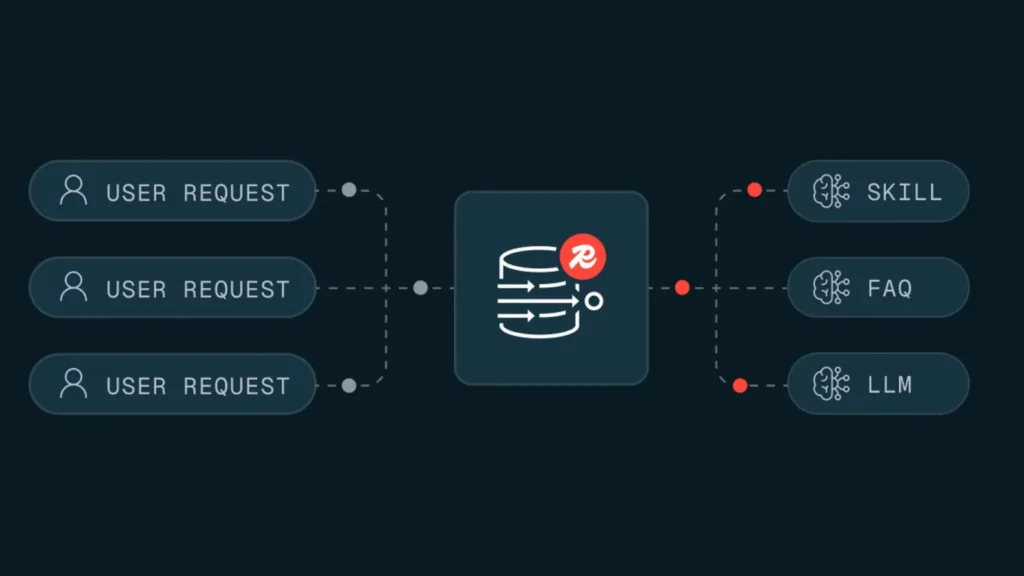
Intent Router matches a request’s meaning rather than its exact wording, then directs it to a remembered FAQ, an agent skill, a human or an LLM. It also supports agent and model routing, guardrails and fuzzy conditional decisions, allowing differently phrased versions of the same request to be handled as the same underlying problem.
Agent Playbooks separates stable answers that can be reused from requests that need current data and a fresh run of a known procedure. Redis said the playbooks become more thorough and accurate with repeated use, cutting resolution times and token spending.
Source
Unite.AI · 4 Nov 2026 · 18:25 CET
Open the original at Unite.AI ↗