AI · 3 Nov 2026 · 17:50 CET
ARIA Selects Lumai Optical Servers for Rack-Scale AI Inference Testing
Publisher preview · OZZZER analysis pending editorial review.
PUBLISHER ARTICLE PREVIEW
From the original article
Lumai is taking its optical AI hardware into a new evaluation setting: the Scaling Inference Lab backed by the UK’s Advanced Research and Invention Agency, or ARIA. The lab plans to deploy Lumai Iris inference servers as its first optical-compute platform, giving researchers a way to test the architecture at rack scale in a commercial data-center environment.
Run by CommonAI CIC, the lab is intended to bridge a difficult gap for emerging AI hardware: demonstrating a novel processor is one thing; making it work as part of an integrated system, with real models and ordinary power, cooling, and rack requirements, is another.
The announcement builds on the April launch of Iris Nova. The new step is a multi-node evaluation through a publicly backed testbed, rather than the release of a completed, independent benchmark proving Lumai’s headline efficiency claims.
Lumai, an Oxford University spin-out founded in 2021, develops a hybrid optical and digital architecture. Its optical engine targets the dense mathematical operations used in AI inference, while electronic components continue handling the surrounding system functions.
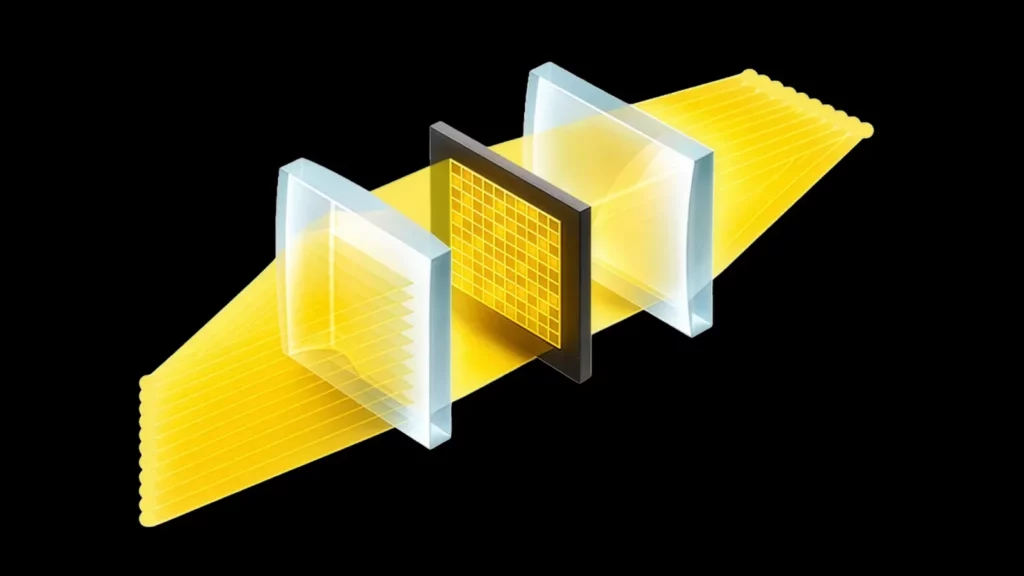
In the company’s technical description, information is encoded into beams of light and processed through optical components in three-dimensional space. The aim is to execute many mathematical operations in parallel through light propagation, rather than perform every calculation by switching transistors.
That does not make the entire server passive or power-free. The full system still needs light sources, data conversion, memory, digital processing, and control. The relevant engineering question is how much of the optical engine’s efficiency survives those surrounding costs when a useful model is actually running.
Lumai describes a wide data interface intended to spread conversion overhead across large workloads, a three-tier memory design for the model’s key-value cache, and hardware-aware quantization.
Source
Unite.AI · 3 Nov 2026 · 17:50 CET
Open the original at Unite.AI ↗