AI Hardware & Infrastructure · 2 Nov 2026 · 20:55 CET
Powering up for a pivotal moment
Publisher preview · OZZZER analysis pending editorial review.
PUBLISHER ARTICLE PREVIEW
From the original article
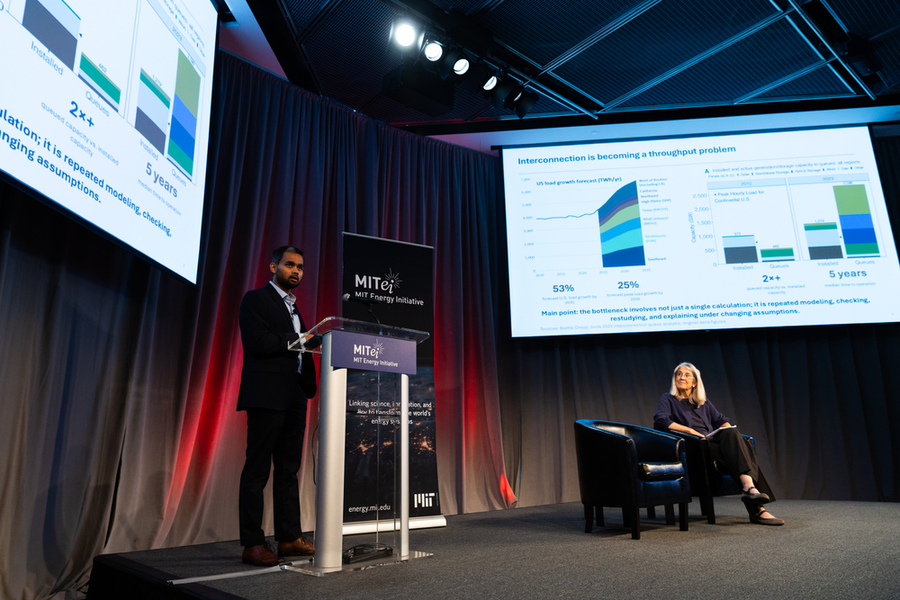
Utilizing waste carbon at scale, assessing public trust in artificial intelligence and data centers, and building a quantum toolkit for critical applications were among the topics energy experts explored at the MIT Energy Initiative (MITEI)’s annual research conference on Sept. 22-23.
The complexity of the energy transition demands “a truly interdisciplinary and international approach,” said Paula Hammond, Institute Professor and dean of the MIT School of Engineering, kicking off the conference, which was themed “Transitioning energy at a pivotal moment.”
More than 200 people attended Energizing@MIT: MITEI’s Annual Research Conference in person and online, including faculty, scientists, and researchers; representatives of global energy firms; nonprofit organizations; and academic institutions.
With the rapid proliferation of artificial intelligence and data centers, the challenge of the energy transition grows ever greater, requiring “researchers who can pursue fundamental questions about materials, chemistry, and energy systems … engineers who can design new technologies and determine how they might function at scale … and experts in economics, policy, human behavior, and sociology who can help us understand how those technologies will interact with communities and with the world around us,” said Hammond.
From keynote speakers to panelists, seed grant innovators to startup entrepreneurs, the conference featured exemplars in all these categories.
Eric Toone, chief technical officer and managing partner at Breakthrough Energy, set the tone for day one with a keynote address that was clear-eyed in his assessment. “If energy is prosperity,” he told the audience, “at least today, prosperity is emissions.” Yet, Toone was optimistic when he heralded examples of Breakthrough Energy-funded ventures, from iron-air batteries to vacuum-insulated glass windows, which can reduce the carbon costs of energy.
“We can absolutely develop new technologies that provide the exact same service, but at zero carbon,” he said.
The conference made Toone’s claim tangible as it spanned the full arc of decarbonization — from deploying what we know today to uncovering what may be possible tomorrow.
There are “projects that are actually being developed, companies that are putting steel in the ground now, electrons onto the grid to deliver capacity now, or in the very, very near term,” said John Parsons, deputy director for research at the MIT Center for Energy and Environmental Policy Research. Parsons moderated a panel on the revival of nuclear fission power.
Source
MIT AI NEWS · 2 Nov 2026 · 20:55 CET
Open the original at MIT AI NEWS ↗