Models & tools · 26 Oct 2026 · 21:49 CET
Fine-Tuning NVIDIA Nemotron to Know Local Rules, Not Just Local Languages
Publisher preview · OZZZER analysis pending editorial review.
PUBLISHER ARTICLE PREVIEW
From the original article
As AI adoption expands globally, people across languages and cultures are using it in more aspects of their daily lives. General-purpose language models serve as a powerful foundation, but they sometimes lack the local knowledge, cultural nuance, and precision a particular application needs.
Post-training can adapt an open model to these needs. With suitable data and evaluation, it can improve accuracy and usefulness while supporting safer interactions with the model. This gives countries and industries greater control over how their agents reflect local priorities and serve the people who use them.
NVIDIA built Nemotron-Personas-France with French AI startup Pleias, and Nemotron-Personas-Belgium with Pleias and Belgian university KU Leuven. Both are part of the open NVIDIA Nemotron data program, which includes locale-grounded persona datasets for 12 countries that developers can use to adapt open models market by market.
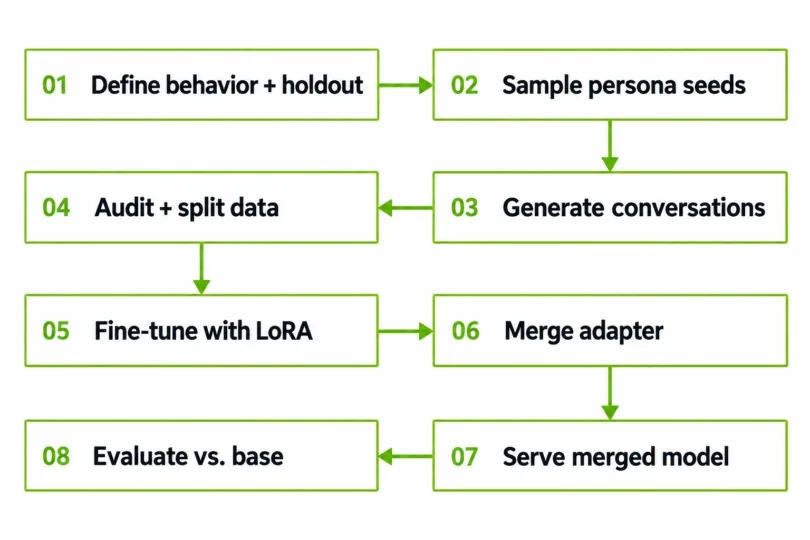
In this blog, we will discuss how to take Nemotron open models and post-train them with Nemotron datasets to tailor them for regional languages and cultures.
Let’s say you are developing an agent for the passport agency in France and the agent gets a customer question like this:…
Je ne peux plus me déplacer à cause de ma santé. Comment faire ma demande de passeport?
(Translation: I can no longer travel because of my health. How do I apply for my passport?)
A typical answer while running a foundation model with no post-training may look like this:…
[…] Si vous êtes dans l’incapacité de vous déplacer, vous pouvez faire votre demande par courrier. […] Adressez le dossier complet par lettre recommandée avec accusé de réception à la direction générale des finances publiques […]
(Translation: […] If you cannot travel, you can apply by post. […] Send the complete file by registered letter with acknowledgement of receipt to the public finances department […])
The response is unspecific, unsupported, and conflicts with actual documentation available on government web pages. For this kind of documentation, a government official must make a home visit for your paperwork—submission by mail is not an option.
To improve an interaction like this, NVIDIA has released the Nemotron-Personas datasets for France and Belgium. Each persona is a synthetic resident grounded in regional demographic, geographic, linguistic, and cultural distributions. A generic persona reads like “a French adult who needs a passport.” A grounded persona has an age, a commune, a job, and a household that follow French census data, plus written profiles of the person’s work and daily life.
That shapes what the person asks and how they ask it. It can also change the right answer: For a resident of French Guiana, the passport stamp costs €43, against €86 in mainland France.
This walkthrough uses France as the example, but the same loop applies to any Nemotron-Personas market. Swap in another released persona dataset, such as Nemotron-Personas-Belgium—which spans Dutch, French, German, and English—update the behavior contract and reviewers, and the rest of the workflow stays the same.
These datasets can be used to generate synthetic conversations for post-training that cover more of the people the agent will serve for better comprehension. The facts in each answer come from official procedure text, which the workflow pairs with each persona.
Si vous ne pouvez pas vous déplacer en raison de votre état de santé, vous pouvez demander qu’un agent se déplace à votre domicile. Pour cela, vous devez fournir un certificat médical de moins de 3 mois attestant de votre impossibilité de vous déplacer. Vous pouvez effectuer cette démarche en ligne via le site de l’ANTS ou en vous rendant dans une mairie équipée d’une station d’enregistrement.
Source
NVIDIA · 26 Oct 2026 · 21:49 CET
Open the original at NVIDIA ↗