AI · 24 Oct 2026 · 16:34 CEST
AI makes junior patent attorneys instantly better but may quietly stunt their professional growth
Publisher preview · OZZZER analysis pending editorial review.
PUBLISHER ARTICLE PREVIEW
From the original article
A three-month field experiment with 133 patent attorneys shows that AI assistance improves immediate performance, especially for junior lawyers. But when the AI is taken away, only senior attorneys retain the benefits.
Whether AI assistance builds or erodes professional expertise is a contested question in research. A working paper from the National Bureau of Economic Research (NBER), a nonprofit U.S. economics research organization, tackles it with a three-month randomized controlled trial across eleven U.S. intellectual property law firms.
The study separated two things by having attorneys first work with AI assistance and then evaluate results without it. This design let researchers measure both the quality of AI-assisted work and how well the attorneys' own judgment held up afterward. Blinded patent attorneys at an independent firm scored all results across five categories: enforceability, technical accuracy, strategic ambiguity, completeness, and clarity.
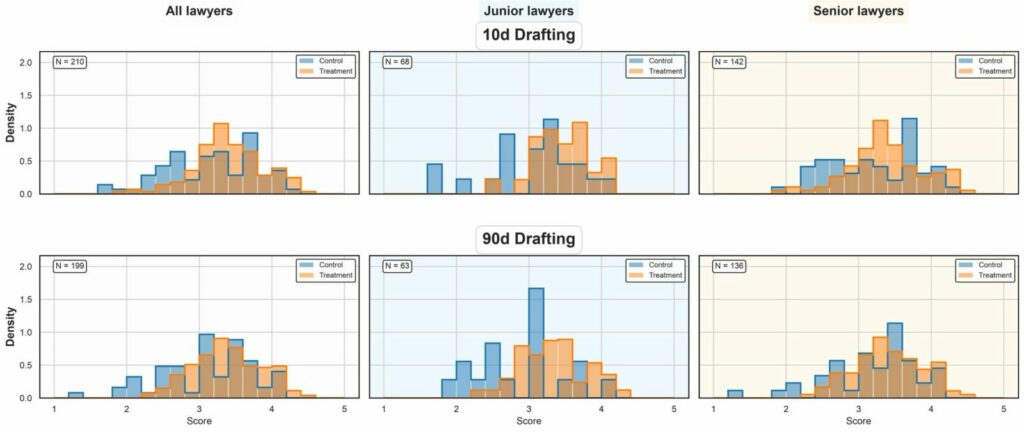
Two-thirds of participants in the Google-funded study got access to "InFlow," an unreleased AI assistant from Google Labs, while the remaining third worked without any AI. In two patent claim drafting tasks, only the treatment group could use InFlow, and the control group completed the same tasks unaided.
In a third task called redlining, all participants had to critically review an existing patent draft without AI. As the authors explain, drafting measures immediate AI-assisted performance, while redlining measures internalized judgment, a task patent attorneys routinely perform without any tools.
In the drafting tasks, the treatment group clearly outperformed the control group at both the 10-day and 90-day marks, with effects showing up across all five scoring dimensions.
Source
THE DECODER · 24 Oct 2026 · 16:34 CEST
Open the original at THE DECODER ↗