AI · 15 Oct 2026 · 18:22 CEST
Voxel51 Unveils Unified Data Platform 3.0 Aimed at Physical AI Teams
Publisher preview · OZZZER analysis pending editorial review.
PUBLISHER ARTICLE PREVIEW
From the original article
Voxel51 on October 15, 2026 introduced Voxel51 3.0, an end-to-end multimodal data platform for physical AI that brings search, curation, annotation, and evaluation into a single extensible system. Co-founder and CEO Brian Moore, writing in the company’s announcement, called it the company’s “most significant release yet,” and teams can now try the platform on their own data for free at app.voxel51.com.
The release also renames the company’s enterprise product: Voxel51 is the new name for FiftyOne Enterprise, while FiftyOne continues to refer to the open-source project. Moore wrote that the company has spent years working with teams deploying AI in autonomous systems, robotics, manufacturing, and healthcare, and rebuilt the platform over the past several months around the data work that begins once a model moves beyond prototype: investigating failures, curating training sets, and evaluating models across real-world scenarios.
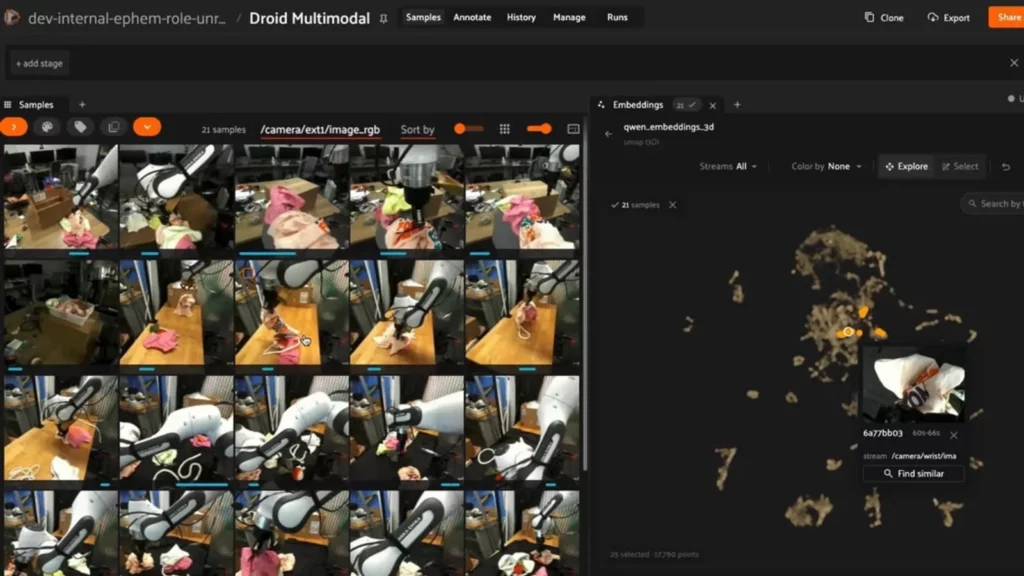
Voxel51 Search is a persistent hybrid search index that combines semantic retrieval with lexical queries and filters across unstructured content and structured metadata in multimodal datasets. According to the announcement, Search automatically indexes datasets and computes embeddings so queries are available from day one, and it keeps embeddings and structured fields queryable in their native form, combining them at retrieval.
For vector retrieval, the platform uses LanceDB, whose columnar architecture supports vector search alongside scalar and full-text indexes while separating storage from compute.
Teams control the embedding pipeline itself, including what data gets embedded, which model and compute to use, and when embeddings are generated, with incremental updates that do not require rebuilding the full dataset.
Source
Unite.AI · 15 Oct 2026 · 18:22 CEST
Open the original at Unite.AI ↗