Coding & Development · 15 Oct 2026 · 17:05 CEST
Trust in Depth: Giving agents more autonomy without losing control
Publisher preview · OZZZER analysis pending editorial review.
PUBLISHER ARTICLE PREVIEW
From the original article
In every conversation I have with enterprise leaders, they say the same thing. They want agents to do more, but they don’t trust them to do it right all the time.
That’s fair. The same creativity and autonomy that makes agents useful makes them hard to trust. Give an agent a task and it finds its own path to finish it, picking tools and sequencing steps no developer scripted. Run the same task twice and it might take a different route each time. A test that passes today tells you little about what the agent does tomorrow.
The usual answer is a person in the loop, approving everything the agent does. That works at small scale, but as agents take on more work, human approvals pile up and review fatigue sets in. People asked to check everything stop catching the things that matter. Caution becomes a bottleneck, and agents capable of far more sit idle on the valuable work that could be making more of an impact.
The fix is to let the agent act on its own when its actions can be verified, and reserve human judgment for the decisions that need it. As agents take on higher stakes work, like financial transactions, a wrong action becomes increasingly harmful. Organizations need the confidence to hand an AI agent important work, knowing it will stay within the limits set, even when no one is watching.
That confidence must be built.
Content filtering, testing, and monitoring each serve an important purpose, but none of these capabilities alone can promise an agent will behave correctly the next time it runs. Trust comes from independent layers that reinforce one another, the same layered discipline the industry has practiced for two decades as Defense in Depth, turned to a new purpose.
Where Defense in Depth limits what can go wrong, this expands what you can safely allow. AWS calls it Trust in Depth.
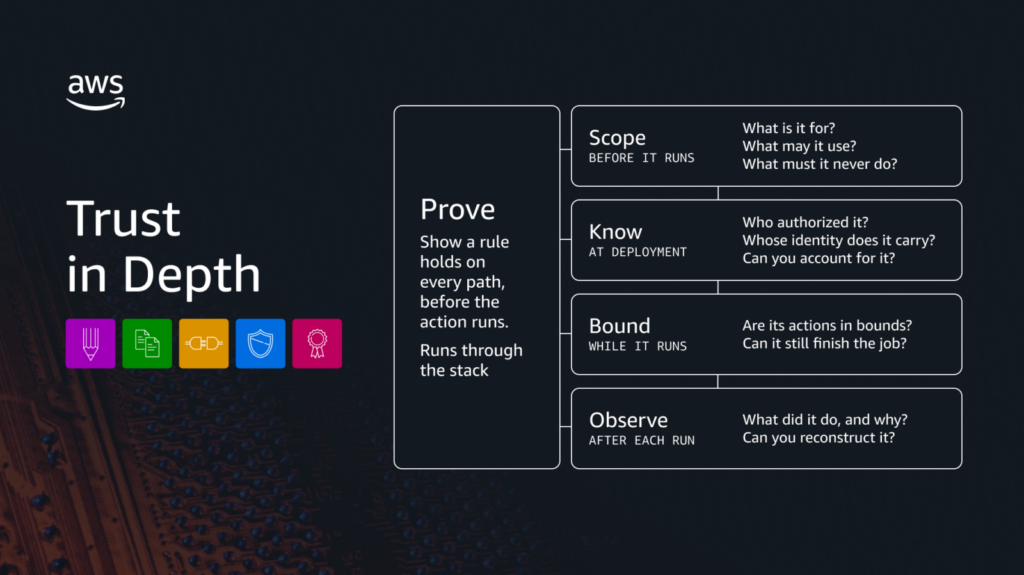
You build trust by answering a set of questions at different moments in the agent’s lifecycle:…
Across these questions, some requirements can be expressed as precise rules, while others call for judgment. A company might require that only a manager can approve access, or that an employee’s sign-in must be blocked before their mailbox can be shared. Other expectations, such as keeping a friendly tone or handling a sensitive situation appropriately, depend on context and human judgment.
For precisely defined rules, testing shows whether the controls work in the cases you anticipate, but an agent takes paths you didn’t. The technology that goes further is automated reasoning, the mathematical logic that checks whether a rule holds in every possible case. It can establish that a rule holds on every path covered by a precise description of the system and its assumptions, or uncover the exact case where it fails.
That result is a proof, and it is only as good as the rules and assumptions behind it, which is why the hardest work comes before the agent runs.
AWS has run automated reasoning in production for more than a decade, from Identity and Access Management (IAM) at more than 2.1 billion requests per second to critical systems like the AWS Nitro Hypervisor, Amazon S3 Block Public Access, and VPC Reachability Analyzer. Now we are bringing it to agents. Wherever an agent’s rules can be stated precisely, automated reasoning can check them.
However, not every rule can be stated precisely. “Only a manager can approve access” can be proven. “Keep a friendly tone” cannot. Where proof does not apply, limit the agent’s access and actions, evaluate its behavior, and send genuine ambiguity to a person to apply judgment. Grant more autonomy as you establish that the relevant rules are enforced, the agent performs reliably on the task, and failures can be detected and handled.
Here is what each Trust in Depth layer asks of you, and how AWS helps you answer it.
Trust begins before an agent runs, and this is where to invest the most effort. Problems caught here are cheap to fix. Scoping means deciding what work the agent owns, which tools, data, and services it may reach, the rules it must follow, and which decisions stay with a person.
“Resolve the customer’s issue” says what to achieve, not how the agent may act to achieve it. The agent still needs limits on what it may see, what it may do, and when it must stop and ask.
Source
AWS AI · 15 Oct 2026 · 17:05 CEST
Open the original at AWS AI ↗