AI Hardware & Infrastructure · 9 Oct 2026 · 00:44 CEST
Scale Bitwise-Deterministic Pretraining with NVIDIA Megatron Core
Publisher preview · OZZZER analysis pending editorial review.
PUBLISHER ARTICLE PREVIEW
From the original article
Bitwise determinism makes large-scale pretraining easier to debug, validate, and resume reproducibly. These benefits become especially valuable when training models with trillions of parameters across thousands of GPUs, where multiple parallelism dimensions, low-precision computation, and distributed checkpointing complicate failure reproduction and fix validation.
Production and hero training runs are expensive and require a strong guarantee of success. Bitwise determinism enables reliable failure replay, loss-spike debugging, system-change validation, and recovery from interrupted training runs. At a trillion-parameter scale, even a small slowdown can cost thousands of GPU-days, so deterministic training must remain efficient. A trillion-parameter Nemotron case study shows how NVIDIA is reducing the overhead of bitwise-deterministic pretraining in NVIDIA Megatron Core.
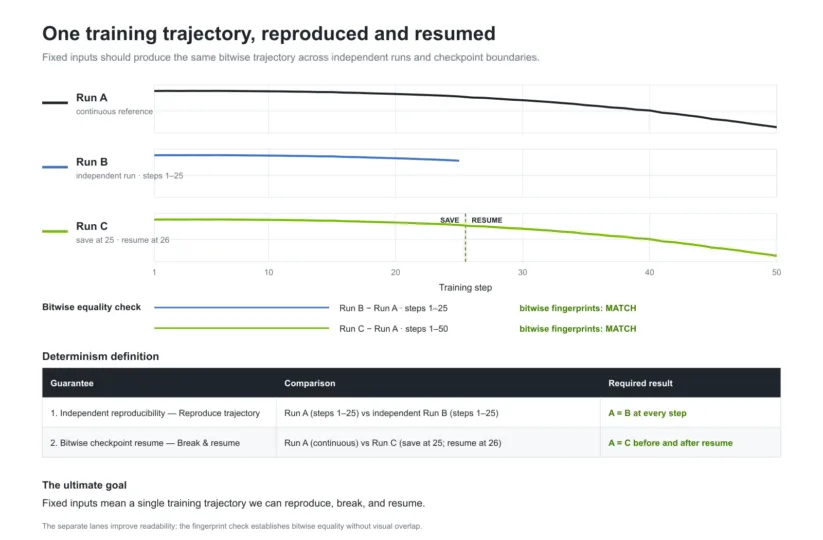
Bitwise determinism requires independent and checkpoint-resumed runs to follow the same numerical trajectory when data order, architecture, recipe, parallelism, software, runtime settings, and hardware are fixed. Megatron Core targets two guarantees.
Independent reproducibility: two runs launched from the same initial state must remain bitwise identical at every training step.
Bitwise checkpoint resume: a run that saves and restores one or more checkpoints must remain identical to an uninterrupted run.
Printed loss values are not sensitive enough to establish bitwise identical numerics. Two runs can print the same rounded loss while differing in the lower-order bits of their gradients or parameters.
A stronger validation procedure fingerprints selected numerical metrics at every step. These can include training loss, language-modeling loss, load-balancing loss, multi-token prediction (MTP) loss, and gradient norm. Run the same configuration twice and compare these fingerprints step by step. The first mismatching step helps narrow the investigation.
To validate the bitwise checkpoint resume, compare an uninterrupted reference run with checkpoint-resumed runs. After every restore, verify that the parameters, optimizer state, RNG state, data position, and subsequent outputs are bitwise identical to the reference.
Source
NVIDIA · 9 Oct 2026 · 00:44 CEST
Open the original at NVIDIA ↗