Robotics · 8 Oct 2026 · 02:55 CEST
Mecka Raises $60M Series B to Scale Robot Data and Deployment
Publisher preview · OZZZER analysis pending editorial review.
PUBLISHER ARTICLE PREVIEW
From the original article
Mecka, a company building data infrastructure for robot learning, announced on October 7, 2026, that it has raised a $60 million Series B led by Sequoia Capital. New investors in the round include NVIDIA, Qualcomm Ventures, Samsung and M12, Microsoft’s venture fund, the company said, with continued support from Kindred, Framework Ventures and Neo.
Angel investors participating include DoorDash founder and CEO Tony Xu, former ServiceNow and Snowflake CEO Frank Slootman, and former Tesla Optimus head Milan Kovac, according to the company. Mecka said the capital scales its data infrastructure, deepens its internal research lab, and builds out commercial robot deployment, work the company describes as the data and deployment layer for robotics.
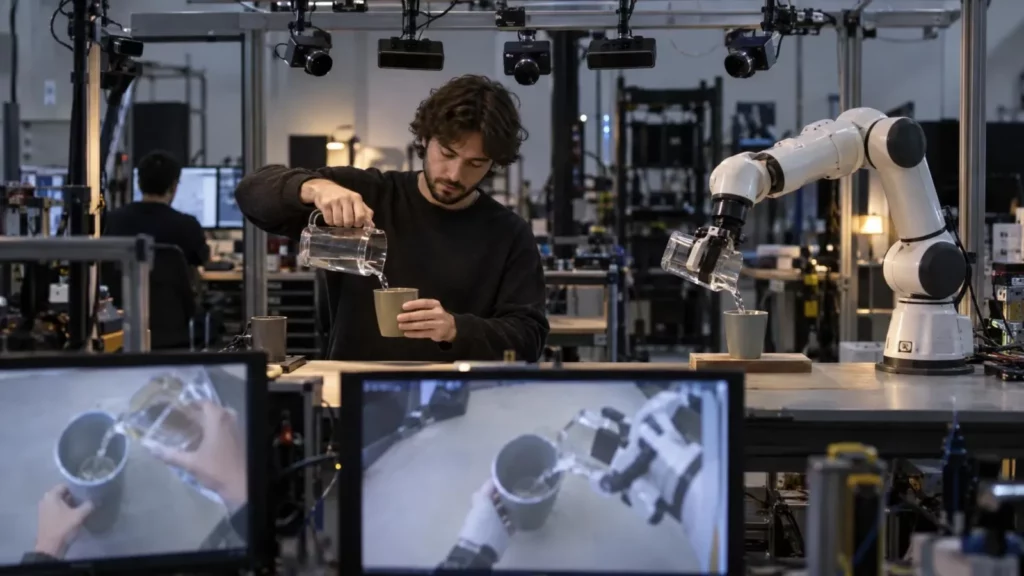
The company’s thesis is that what robots lack is experience. No one ever wrote down how a hand grips, folds or pours, how hard to press, or when to let go. “Motion, contact, force and geometry aren’t on the internet. You can’t scrape them, license them or buy them,” the company wrote in its Series B announcement.
Mecka describes that gap as the biggest bottleneck in robotics, calls robotics the largest productivity opportunity ahead, and predicts data will become a trillion-dollar market.
On its website, the company describes a series of challenges between raw activity and usable training data. Real-world tasks are noisy, so models need large-scale edge cases and task-specific demonstrations to generalize. Raw video is not enough: teams need annotation, context, quality assurance, motion understanding and evaluation workflows before real-world activity becomes useful training data.
Finally, the lab is not the finish line: robotic systems must be tested against real workflows, environments and constraints before they can work in the field.
Source
Unite.AI · 8 Oct 2026 · 02:55 CEST
Open the original at Unite.AI ↗