Automation & Agents · 5 Oct 2026 · 23:10 CEST
NVIDIA AVO Reaches 100% on ARC-AGI-3, Demonstrating a Frontier-Level General-Purpose Architecture for Long-Horizon Autonomous Agents
Publisher preview · OZZZER analysis pending editorial review.
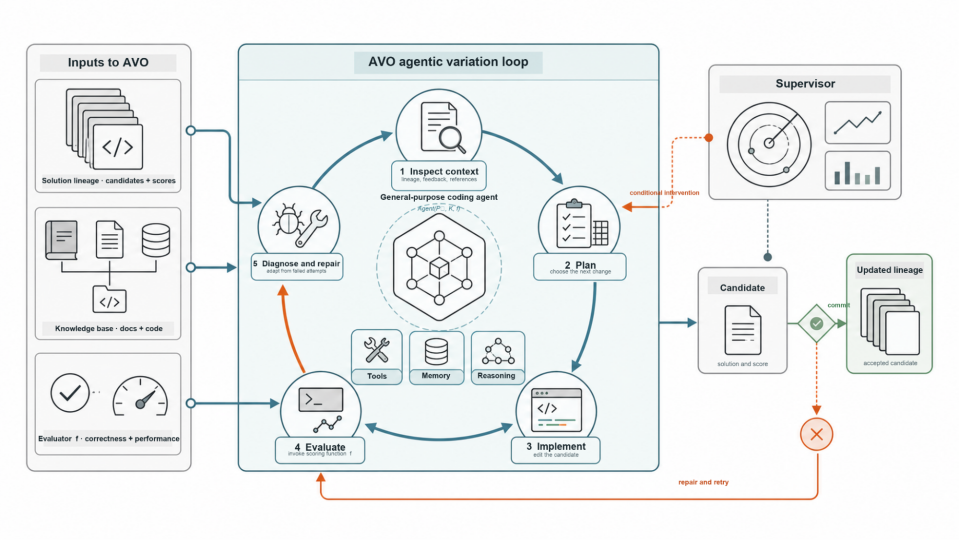
The research project elevates Claude Opus 5 from a 30% model baseline to 100% as part of the complete AVO agent system, showing that system design—not model capability alone—can unlock frontier-level long-horizon performance. A frontier language model is only one component of an AI agent. The surrounding agent system—often called a harness—determines how the model receives context, uses tools, maintains state, responds to feedback, recovers from failure, and sustains progress over long-running tasks.
The challenge is how to build the agent architecture that makes frontier language models work reliably on extended, multistep tasks. The NVIDIA research project Agentic Variation Operators (AVO) addresses this challenge of building a general-purpose agent architecture. AVO was first demonstrated on difficult software engineering and GPU-kernel optimization tasks, where success requires far more than generating code in a single response.
An agent must inspect existing implementations, form hypotheses, make changes, execute hardware-grounded tests, interpret feedback, and repeatedly revise its approach. This post introduces the AVO architecture and the system-level mechanisms that enable it to sustain long-running autonomous work. We first summarize its application to GPU-kernel optimization,…
Excerpt supplied by the publisher.
Source
NVIDIA · 5 Oct 2026 · 23:10 CEST
Open the original at NVIDIA ↗