AI · 5 Oct 2026 · 14:00 CEST
AI Solves a Major Unsolved Math Problem. Not Everyone Is Happy
Publisher preview · OZZZER analysis pending editorial review.
PUBLISHER ARTICLE PREVIEW
From the original article
OpenAI’s recent claim of solving a Millennium Prize problems causes both celebration and controversy
Benjamin Skuse is a freelance writer of all things science and technology. He holds a Ph.D. in applied mathematics.
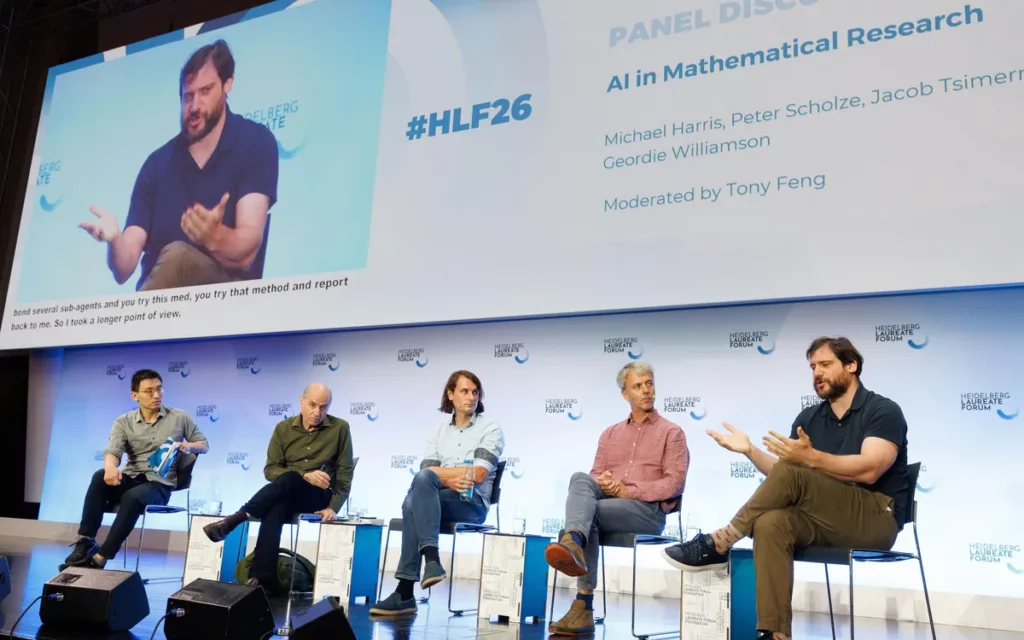
From left to right: Moderator Tony Feng, and panelists Michael Harris, Peter Scholze, Geordie Williamson, and Jacob Tsimerman debate the impact of AI on mathematical research at the Heidelberg Laureate Forum 2026.
On 13 September, leading luminaries and up-and-coming talents in mathematics and computer science congregated at the annual Heidelberg Laureate Forum in Germany for a week of discussion, networking, and—naturally—wurst.
Having attended several of these events in the past, the mathematicians’ chatter is normally concerned with which famed researchers are attending, or what interesting problems they have been working on. But instead, every snippet of conversation caught in passing or any debate accidentally overheard was about how AI companies such as OpenAI, Anthropic, and Google are steamrollering their way through mathematics.
And there is good reason for these fervent discussions. Mathematics is the perfect testing ground for AI, involving step-by-step logical reasoning and answers that are automatically and objectively verifiable. This has led tech giants to develop their AI mathematical capabilities at a terrifying rate this year, leading to both new solutions to previously unsolved problems and a reckoning within the community as to what it means to do math in the age of AI.
In short order, AI has gone from struggling with everyday research-level problems to solving a whole raft of teasers posed by prolific Hungarian mathematician Paul Erdős, then verifying the proof of Fermat’s Last Theorem, and—most recently and famously—OpenAI announcing they had solved the Navier–Stokes existence and smoothness problem. As attendee and young researcher Ailsa Robertson (University of Amsterdam, The Netherlands) put it: “AI and LLMs set the math community on fire over summer.”
One of seven extremely difficult Millennium Prize Problems posed in the year 2000 by the Clay Mathematics Institute (only one, the Poincaré conjecture, has been solved by humans so far), OpenAI’s claim to have solved the Navier–Stokes existence and smoothness problem represents a watershed moment for automated reasoning, if verified.
Source
IEEE Spectrum AI · 5 Oct 2026 · 14:00 CEST
Open the original at IEEE Spectrum AI ↗