Models & tools · 3 Oct 2026 · 12:21 CEST
Deepmind researchers propose "Artificial Symbiotic Intelligence" as an alternative to the singularity
Publisher preview · OZZZER analysis pending editorial review.
PUBLISHER ARTICLE PREVIEW
From the original article
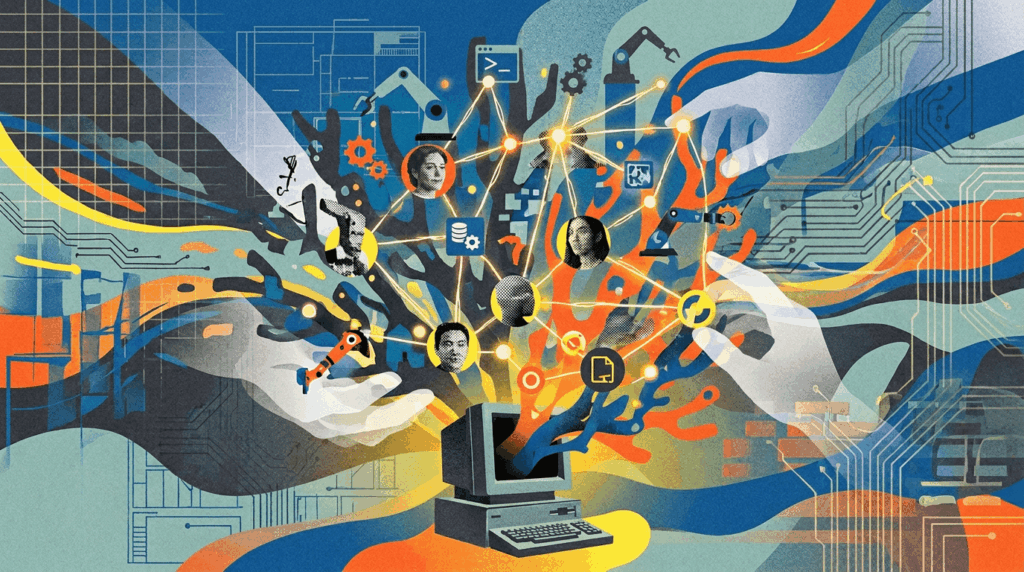
An essay for the Deepmind Institute challenges the familiar image of a lone superintelligence. The authors envision networks of agents, hybrid institutions, and what they call "Artificial Symbiotic Intelligence."
Google-affiliated researchers Benjamin Bratton, Blaise Agüera y Arcas, and James Manyika argue that artificial general intelligence, or AGI, will emerge from a social system in which people and AI agents work together. Some of today's most capable AI systems already use frameworks that divide work among several models and coordinate them as teams.
That shifts the central challenge for AI research, the authors say. Researchers must coordinate and govern a complex network of agents, people, and the systems that connect them, rather than build an isolated machine intelligence. Intelligence, in this view, is a social phenomenon, not an individual trait.
The authors call their vision "Artificial Symbiotic Intelligence," an ecosystem in which people and machines coexist over time, shape one another, and make decisions together. The idea directly challenges the notion of a "singularity" driven by a single superintelligence that continually improves itself.
The argument builds on two earlier papers from the authors' circle. In the preprint "Agentic AI and the next intelligence explosion," James Evans, Benjamin Bratton, and Blaise Agüera y Arcas developed the social and institutional perspective behind the new essay.
A second preprint provides empirical support. In "Reasoning Models Generate Societies of Thought," Junsol Kim, Shiyang Lai, Nino Scherrer, Blaise Agüera y Arcas, and James Evans study reasoning models such as DeepSeek-R1 and QwQ-32B. Their analysis of reasoning traces suggests that these models often produce patterns resembling internal debate, shifting perspectives, raising objections, and reconciling conflicting approaches.
This behavior emerges during training rather than being explicitly programmed. When reinforcement learning rewards models only for reasoning accuracy, they develop multi-perspective, conversational behavior on their own. The Deepmind essay extends this finding from individual models to the possible design of societies made up of people and agents.
The authors frame this development as a possible historical break. Urbanization, the growth of specialized professions, and falling birth rates linked to rising prosperity are shrinking human populations in industrialized countries.
Source
THE DECODER · 3 Oct 2026 · 12:21 CEST
Open the original at THE DECODER ↗