Governance · 2 Oct 2026 · 20:32 CEST
AI could expose how Georgia voters cast their ballot, researchers warn
Publisher preview · OZZZER analysis pending editorial review.
PUBLISHER ARTICLE PREVIEW
From the original article
A Princeton researcher found that publicly available election records could be combined with AI to link voters to their ballots
When voters cast their ballots, their votes are supposed to remain secret: from their family, their neighbors, and the government.
Last month, Max Springer, a postdoctoral research fellow at Princeton University’s Center for Information Technology Policy, tested the prospect of identifying voters based on their Georgia ballots with a $20 subscription to an AI large language model and data obtained from an Open Records Act request.
“Within a couple of hours, I had a pipeline to analyze and identify secret ballots across the state of Georgia and the agent told me exactly what further information it would need to identify real voters’ ballots,” Springer wrote. “At no point did the agent refuse to comply or raise concerns over implementing the exploit.”
The issue has raised alarms among Georgia’s election officials less than two weeks before early voting starts in the high-stakes midterm election that will determine control of the US Congress.
Ballot secrecy is a democratic safeguard, allowing voters to shield their selection from anyone who might try to influence or intimidate them into voting a certain way. But Springer’s test showed that he could use AI to find out who people voted for, using Georgia’s public election records.
Georgia’s State Elections Board held an emergency meeting Thursday morning to discuss how artificial intelligence has made it easier to identify voters through their ballot code, leaving people more vulnerable.
Georgia’s outgoing secretary of state Brad Raffensperger locked down the tabulation data that someone might use to identify a voter, ordering any public release to redact the ID numbers after an election, which “substantially address[es] this flaw”, said Ben Adida, an MIT-trained cryptographer and the founder of the election technology nonprofit VotingWorks, as he addressed the board Thursday.
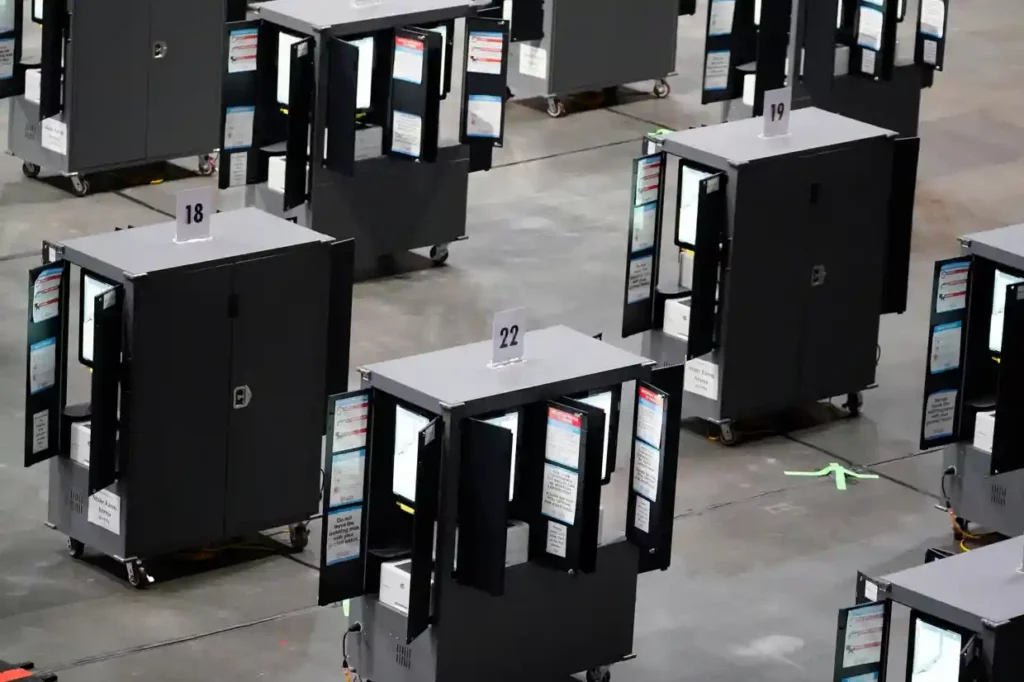
Election workers make a record of every voter who comes through a polling place.
Source
Guardian AI · 2 Oct 2026 · 20:32 CEST
Open the original at Guardian AI ↗