Automation & Agents · 1 Oct 2026 · 21:58 CEST
Trump’s ‘Morally Binding’ AI ‘Accord,’ the Rise of AI Agents, and Extremists on the Ballot
Publisher preview · OZZZER analysis pending editorial review.
PUBLISHER ARTICLE PREVIEW
From the original article
This week on Uncanny Valley, Brian Barrett, Zoë Schiffer, and Leah Feiger discuss the “morally binding” AI accord tech executives signed following a meeting with Donald Trump. They’ve agreed that AI labs will regulate themselves—should work out great. Plus, the team digs into OpenAI’s Developer Day, where CEO Sam Altman introduced AI agents for normies, otherwise known as Dots; how AI agents are coming to workplaces near you; and a quick rundown of the most extremist candidates running for office.
You can follow Brian Barrett on Bluesky at @brbarrett, Zoë Schiffer on Bluesky at @zoeschiffer, and Leah Feiger on Bluesky at @leahfeiger. Write to us at [email protected].
You can always listen to this week's podcast through the audio player on this page, but if you want to subscribe for free to get every episode, here's how:
If you're on an iPhone or iPad, open the app called Podcasts, or just tap this link. You can also download an app like Overcast or Pocket Casts and search for “uncanny valley.” We’re on Spotify too.
Brian Barrett: Hey, this is Brian. Two quick things before we dive in. If you've been listening for a while and you haven't rated or reviewed the podcast yet, this is your sign. Give us a rating, tell us what you think. Five stars is nice, but we'll take the feedback too. It really helps more people find the show.
Also, if you're in the Bay Area, we will be doing a live audience recording of the podcast on Thursday, October 8, at 7 pm at The Commons, headquarters of our KQED friends in San Francisco. You can buy tickets on kqed.org or check out the show notes for the link. You won't want to miss it.
OK, onto the show.
Zoë Schiffer: Welcome to WIRED's Uncanny Valley. I'm Zoë Schiffer, contributing editor.
Brian Barrett: This week we've got a new proclamation or rather a "morally binding" AI accord from the White House. After a meeting between tech executives and Donald Trump, it basically says the AI labs are going to regulate themselves. Should work out great. Plus we'll talk about OpenAI's Developer Day, where CEO Sam Altman announced the company's new always-on AI agents for regular folks.
More AI agents again, should work out great. Everything's working out great today.
Zoë Schiffer: Yeah. And as AI agents become way more popular in Silicon Valley and beyond, employers are pushing to have these agents harmoniously work alongside human employees. We'll get into how that process is actually going and what the chances are that we're all going to have to welcome some bot colleagues very soon.
Leah Feiger: And with the midterm elections closing in, we're going to be talking about some of the extreme candidates running for office. It's not just political candidates who feel emboldened to say whatever they want. It's also people who are currently or have been recently working for the government, including a retired army colonel turned Pentagon influencer who WIRED reported this week, posted plenty of praise for dictators and has a plan to strip the vote from anyone without kids.
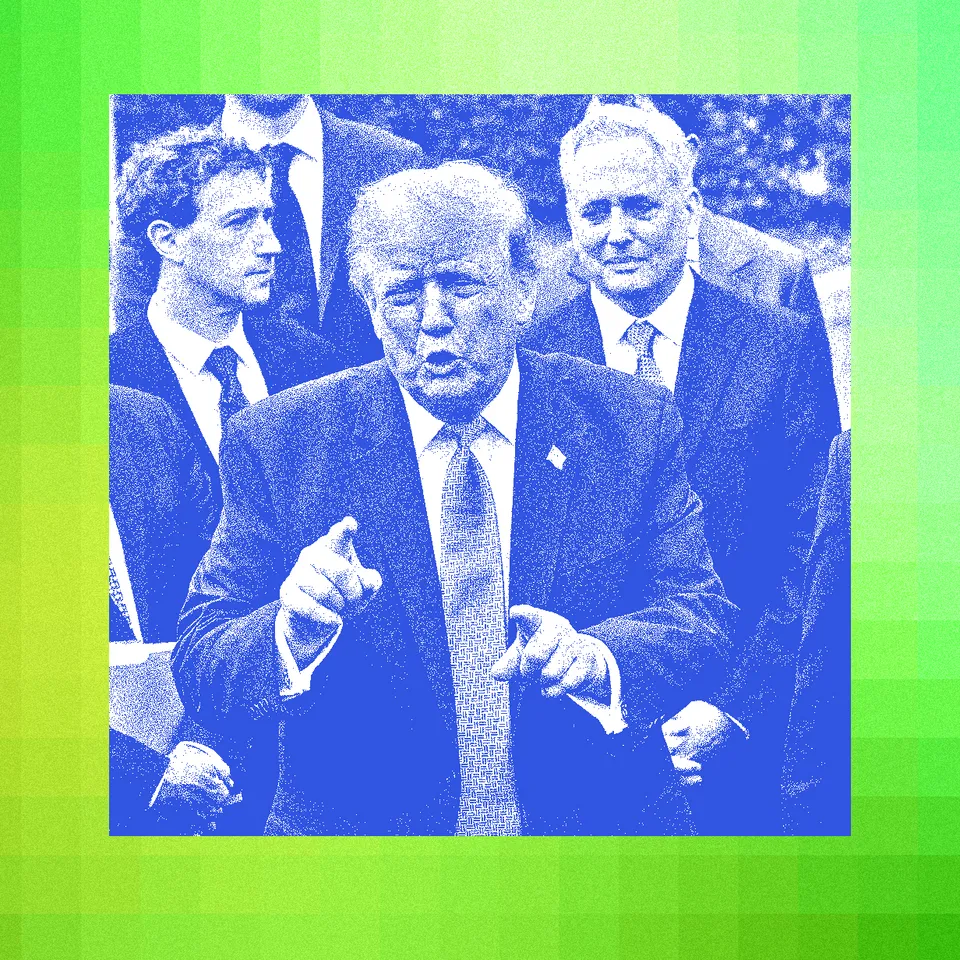
Brian Barrett: Let's start though with a nice luncheon that happened on Tuesday. President Trump invited all his favorite AI executives over to the White House. He had Sundar Pichai, Elon Musk, Dario Amodei, Mark Zuckerberg, Jensen Huang, OpenAI President Greg Brockman, not OpenAI CEO Sam Altman, plus a lot of companies that I was less familiar with.
It felt like a little bit of a motley crew in some ways, but that's neither here nor there. They came out with a signed document called the White House Accord on Super Intelligence. Super intelligence, of course, how the government is now referring to AI, artificial intelligence. But in this accord, the companies agree that they should put their models through four layers of controls and audits.
That includes internal evaluations, letting an outside audit firm come in and make sure everything's OK, and having the company's own board review those audits. And it's all voluntary.
Leah Feiger: That remains the keyword here. When it ever comes to any sort of proposed regulation at all that we've seen thus far in the AI space when it comes to the White House, voluntary is the word. I don't know, is it so silly of me to be so hung up on this that none of this is real?
This is all fake.
Zoë Schiffer: Yeah, I don't think we were expecting the Trump administration to come out with real regulations for AI companies. Their big thing is—
Zoë Schiffer: AI growth. But yeah, I mean when they came out, Trump came out in front of the White House with all of the CEOs, their kind of takeaway message was like, "We got this. We take it seriously. Don't worry about it." And I think it was actually stated by someone there like, "We'll regulate each other.
We're looking out for each other."
Leah Feiger: I mean, we have to talk about this one particular moment. It's been gathering all sorts of attention online, where Dario Amodei is sort of awkwardly pushed to the front of the microphone to share some words and Trump praises him saying "Whatever he says is OK," which is great. So here's what he said.
Archival audio: Can we just bring Dario to the front for a second?
Brian Barrett: He does not want to be in the front, at all.
Archival audio: So I just want to hear from you after this big summit where you are today.
Dario Amodei, archival audio: Look, I mean I will say what I've always said, which is that AI has incredible benefits. I've talked about them ...
Leah Feiger: I have so many thoughts. The first of which is Mark Zuckerberg trying to have a side chat with Trump during that.
Zoë Schiffer: —and Trump are just off to the side making faces with each other.
Leah Feiger: I mean, look, this was all clearly such a rushed job. I can't help but think this is just sort of a way to tell the American public a couple of weeks ahead of midterms, "Don't worry, we have the regulation situation under control. Here are the richest, most powerful men in the country lined up telling you we're going to regulate it.
It's all good. We're aware this is not doing well with polls right now, but we've got this." It just feels like a grab bag. Which perhaps is most emphasized by the fact that the words US were quite literally misspelled in the accords document. It reads President of the Unites States under Trump's signature, which is, I don't know, I'm not saying they quickly rushed this together, slap dash, signed it on, flew people out, but I'm not saying it doesn't look like they didn't do that either.
Brian Barrett: Can I say one thing that is weird about this to me? Or not weird, but the AI labs are in such an uncomfortable position, not that I have that much sympathy for them, but they want some meaningful regulatory framework because they're worried about being investigated for antitrust if they don't have some sort of go ahead to slow down, all this.
But then the day after, so on Tuesday they have, hey, here's this framework. Everything's going to be fine. Y'all self-regulate. And then on Wednesday, the FTC says that they are ramping up a big probe of Anthropic and OpenAI and other frontier labs about the dangers that their technology poses to consumers. So you're sort of getting it from both sides from the government.
Zoë Schiffer: Yeah. And we have Lina Khan writing an op-ed in the New York Times today saying they actually can be tried under existing laws. We don't necessarily need to make new laws, with the big caveat that Congress would have to act.
Leah Feiger: And senior political correspondent Hugo Lowell for his newsletter this week for WIRED also wrote about how team Trump is very aware that the polls are not in their favor. It does not look like they're going to be winning Congress. And as a result, they're starting to look ahead into the future and to how to avoid all of these subpoenas and investigations the Democrats are sure to slap them with.
So with that in mind, I have no doubt that you are right, Brian. Everyone's kind of looking at this going, okay, this is our moment right now, but what is this going to look for us, not even just in a couple of years when Trump's out of office, but in a couple of months when Democrats ostensibly are going to control the House and Senate.
Zoë Schiffer: I personally think Republicans are going to do great in the midterms, but you can cut that because I am not reporting on politics and that's just my vibe check.
Leah Feiger: I'm changing my mind constantly. Right now, I think that with gas prices the way that they are and certain polls coming back the way that they are, it will be really surprising to me if the Democrats manage to lose this. Not Republicans win this, this would require the Democrats messing up, which again, all possible.
Zoë Schiffer: Going back to the AI summit and luncheon, Brian, were you or were you not surprised to see not a hint of an Apple representative?
Brian Barrett: A little bit. Apple has been, they were the ones who memorably Tim Cook presented Donald Trump with a golden trinket.
Brian Barrett: No big enough. Not a big enough trinket. Do you read it, Zoë and Leah, as Apple just not being relevant enough in AI still today?
Brian Barrett: I think they would be there in a heartbeat if they were invited.
Zoë Schiffer: Not because the AI agent ... They just have distribution and so Meta's AI can be so popular so fast because they can shove it down everyone's throats and that's exactly what they're doing. And they're basically promoting a free AI agent that they're subsidizing pretty heavily at the moment. And so yeah, but I think Apple is just frankly not in the game.
Not in the game.
Brian Barrett: Talking of AI agents and Muse is what we're talking about. Meta's Muse AI agent has taken the app store by storm, but that's because it hasn't had much competition until on Tuesday, as we said, OpenAI had its Dev Day. And in his big keynote speech, Sam Altman walked on stage and devoted most of his time to Dots, which is OpenAI's answer to Muse.
It's their always-on agents. You can interact with them through ChatGPT or Slack. The features are pretty established at this point. You can basically tell your agent to go do whatever task online for you and they will get it done. Zoë, I know, has been playing around with her own agents. You're much deeper into that than Leah and I are.
Two things here. One, how much does OpenAI need Dots to connect in order to maintain its position in the AI race? And two, how'd they do in terms of adorability? They're really going for adorability, they're trying to make them adorable, I don't think they quite connected. I think Muse is cuter. There, I said.
It doesn't mean you should use either of them.
Brian Barrett: I'm joking, but the whole point of I think the fact that they're making these so cutesy and fluffy and adorable is obviously intentional. It is what is going to win over the average consumer and make you forget that you are giving away all of your privacy and all of the information and all of your accounts to this adorable fuzzy-wuzzy little thing instead of a data center.
Leah Feiger: Is that part of internet safety conversations now, Brian? When you sit around with your kids and you're like, you're going to have access to this, don't be fooled by the fuzzy avatar. They just want your bank details.
Brian Barrett: Yeah, I think don't hang out with fuzzy avatars online is a well-established directive for children.
Leah Feiger: Brian's rules for the road folks. You've heard it here.
Zoë Schiffer: Yeah. Well, I was just going to say, I was at the Developer Day yesterday, and I had a few observations. On one hand, OpenAI does seem really focused right now. I heard from people at the company that they shipped Dots, these kind of cute, fuzzy, always-on agents within a matter of weeks.
They saw Instinct and Muse, these other kind of OpenClaw for normie-type agents and were like, "OK, we have to play this game." And they got it together really, really fast.
Source
WIRED AI · 1 Oct 2026 · 21:58 CEST
Open the original at WIRED AI ↗