Automation & Agents · 1 Oct 2026 · 20:31 CEST
How to Evaluate AI Agents From Tool Calls to Task Completion
Publisher preview · OZZZER analysis pending editorial review.
PUBLISHER ARTICLE PREVIEW
From the original article
When you ship an AI agent, the key question is whether it can execute a chain of work across dozens of sequential tool calls against a live environment, and recover when a step fails. Scoring whether the model sounds right tells you almost nothing about whether the work finished.
That gap is why agent evaluation has had to evolve from scoring a single function call to scoring an entire task, with tool calling as the connective tissue underneath. This post traces that arc and explains why nearly every serious agent benchmark now rests on tool use.
The original harnesses were built for static tasks. The first model-agnostic, open-source harness decoupled the model from the evaluation protocol.
Agents broke this assumption. Operating across multi-step tasks, an agent calls tools, handles errors, and observes results over many steps, making a single output string insufficient. The Berkeley Function-Calling Leaderboard (BFCL) emerged to evaluate function selection and argument accuracy across single- and multi-turn scenarios. However, BFCL only evaluates individual calls—a valid issue_refund call still fails if underlying checks or updates were skipped.
Call accuracy is necessary, but not sufficient.
Full agentic evaluation now requires a full execution environment: one that executes each tool call, tracks state across steps, and reads the world afterward to decide whether the work got done.
Step-level tells you where the chain breaks, which is what you want when debugging or targeting fine-tuning effort; E2E collapses a failure on step one and a failure on step nine into the same “task failed.” E2E is what your users actually experience, which is why most production evals gate the release on it and keep step-level tracing underneath for debugging.
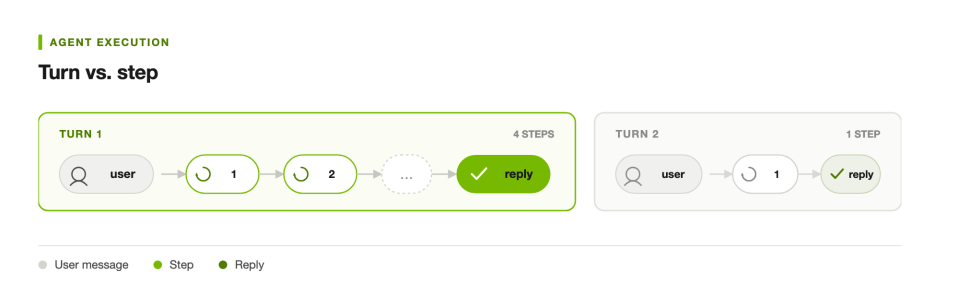
Those two scores are two readings of one object: the trace. A trace is the ordered log of a single attempt: the user message, each step, and the environment state when the attempt stops. Process scoring grades the rows. E2E scoring grades the final state.
A tool-calling benchmark scores three things in order: deciding to use a tool, selecting the right one, and populating its arguments. A model that reaches for a tool when a direct answer would fail as surely as one that skips a tool it needed. Cost and
Source
NVIDIA · 1 Oct 2026 · 20:31 CEST
Open the original at NVIDIA ↗