Automation & Agents · 1 Oct 2026 · 20:31 CEST
Accelerating a ROS 2 Node with an AI Agent and NVIDIA Isaac ROS
Publisher preview · OZZZER analysis pending editorial review.
PUBLISHER ARTICLE PREVIEW
From the original article
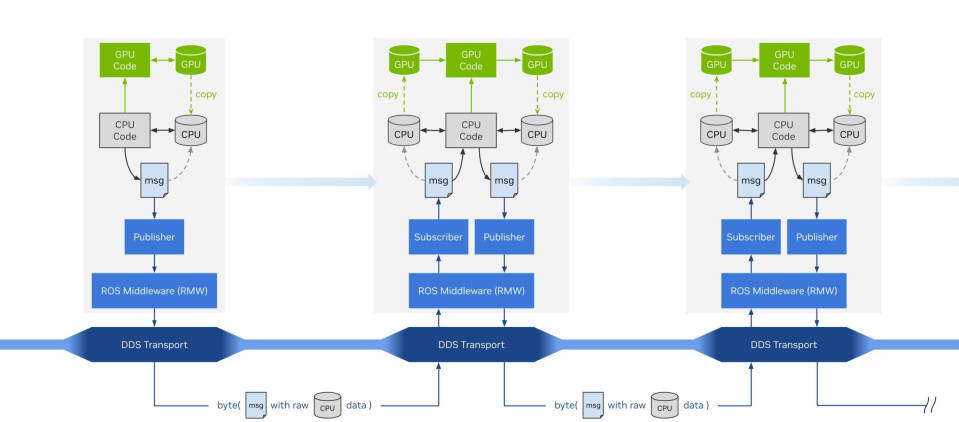
GPU acceleration can speed up compute-intensive robotics workloads, but a fast CUDA kernel alone does not guarantee a fast ROS 2 graph. As messages move between nodes, they may continue to be serialized or copied through CPU memory, eroding the benefits of keeping perception and AI workloads on the GPU (Figure 1).
With the upstream rosidl::Buffer abstraction and the CUDA buffer backend that NVIDIA recently contributed to ROS Lyrical, ROS 2 nodes can exchange GPU-resident payloads through zero-copy transport when runtime conditions allow, while preserving standard ROS 2 messages and node boundaries. All nodes in NVIDIA Isaac ROS 5.0 have been updated to use the CUDA buffer backend and benefit from the more efficient data movement enabled by rosidl::Buffer.
Existing ROS 2 nodes can adopt rosidl::Buffer with minimal changes. The more challenging task is identifying the correct boundaries to update. This requires a careful audit of allocations, serialization, stream ownership, and fallback behavior.
This tutorial walks you through how to turn that audit into an agent-driven workflow. An AI coding agent uses the purpose-built migrate-node-to-rosidl-buffer skill to inspect an existing CUDA-accelerated node, trace data movement, plan a minimal interface-preserving refactor, and verify that the CUDA transport path is actually enabled. You’ll learn how to use the agent skill to update the node to adopt the CUDA buffer backend.
The resulting accelerated workload can then be deployed on NVIDIA Jetson AGX Thor.
In ROS 2 Lyrical, variable-length primitive array fields such as uint8[] are represented in generated C++ code by rosidl::Buffer. The default CPU-backed rosidl::Buffer behaves like the std::vector interface existing ROS 2 code expects, preserving source compatibility. The pluggable abstraction also allows platform vendors to support externally managed storage without defining a separate ROS message type.
NVIDIA contributed the CUDA buffer backend for ROS 2 Lyrical. It implements rosidl::Buffer storage with CUDA Virtual Memory Management (VMM). When publisher and subscriber meet backend runtime requirements, the payload can move between co-located nodes without serialization or host copies. Otherwise, ROS 2 automatically falls back to the CPU path that’s compatible with any existing ROS 2 nodes.
The optimized path requires the same host, CUDA device, Linux user, and a supported RMW implementation (for example, rmw_fastrtps_cpp and rmw_zenoh_cpp).
Together, rosidl::Buffer and the CUDA buffer backend move memory sharing and data-lifetime management behind a standard ROS 2 field. This means the upstream capability is easier to adopt in GPU-accelerated robotics applications, so you can focus on node logic while retaining CPU fallback for incompatible peers.
This tutorial uses the Depth Anything 3 (DA3) TensorRT ROS 2 node as the example. The DA3 model predicts spatially consistent geometry from an arbitrary number of visual inputs, with or without known camera poses.
We aim to update this node to adopt the introduced CUDA buffer backend to take advantage of the performance improvement offered by the rosidl::Buffer feature. The node is particularly useful as a migration example because its algorithm is already GPU-accelerated.
This node’s callback converts the incoming ROS image to an OpenCV
Source
NVIDIA · 1 Oct 2026 · 20:31 CEST
Open the original at NVIDIA ↗