Coding & Development · 1 Oct 2026 · 20:31 CEST
How SWE-Serve Exposes the Gap Between Local Tests and Live Serving
Publisher preview · OZZZER analysis pending editorial review.
An AI coding agent’s patch can pass tests yet fail when the server loads a real model and handles requests. Evaluating changes to inference-serving software therefore requires checking the full serving path, including whether the system returns correct results through its public interface. Developed with input from the SGLang team, SWE-Serve evaluates this gap with 53 tasks derived from merged changes to SGLang, an open-source system for serving large language models.
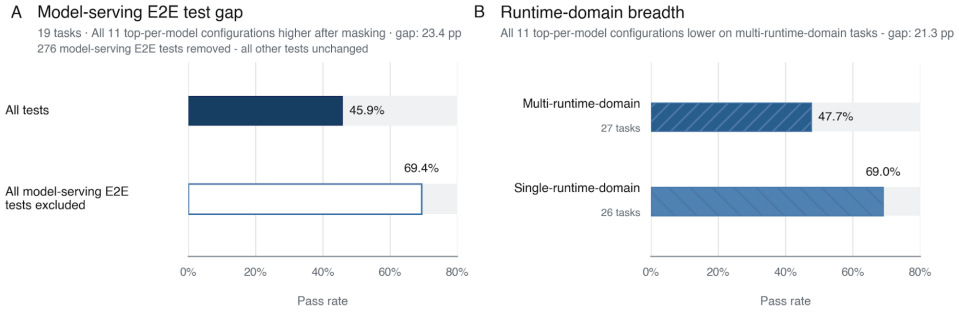
Across 19 tasks with live-serving checks, the same patches passed 69.4% of the time when those checks were excluded, but only 45.9% with the complete verifier. About one in three patches that passed the other checks failed live-serving tests. Quick links: Read the paper | Explore the leaderboard | Run SWE-Serve on GitHub Existing repository-level benchmarks evaluate coding agents across general software-engineering tasks, while inference benchmarks often concentrate on kernel generation or performance optimization.
SWE-Serve instead tests repository-scale changes across the inference-serving stack, including model enablement, decoding, caching, scheduling, serving APIs, and runtime performance. To evaluate this broader engineering work, SWE-Serve turns 83 merged SGLang pull requests into 53…
Excerpt supplied by the publisher.
Source
NVIDIA · 1 Oct 2026 · 20:31 CEST
Open the original at NVIDIA ↗