Research · 1 Oct 2026 · 14:02 CEST
Honda, Redwire Pair Robotic Hand and Arm for Space Station Research
Publisher preview · OZZZER analysis pending editorial review.
PUBLISHER ARTICLE PREVIEW
From the original article
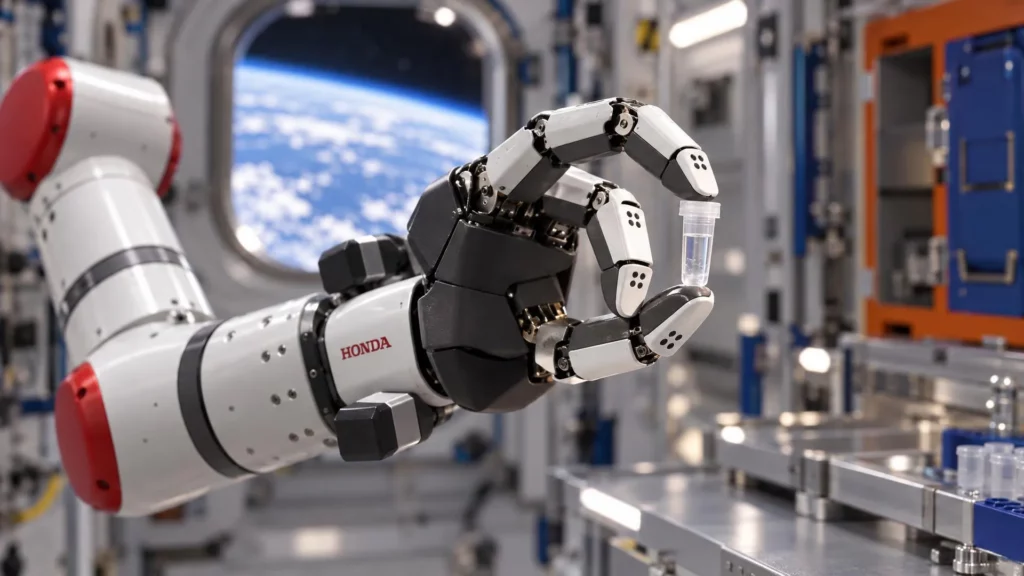
Honda announced on October 1, 2026, that its U.S.-based space development team is engaging with Redwire to develop a robotics solution for future commercial space stations, pairing the Honda multi-fingered robotic hand with Redwire’s STAARK robotic arm and experiment locker technology for research operations in orbit. Honda says the solution aims to increase research capacity while reducing the crew time astronauts spend on experiments and laboratory tasks.
The announcement, issued from Torrance, California, frames the concept around NASA’s transition from the International Space Station to commercially operated stations in low Earth orbit. According to Honda, station developers are evaluating how research and routine laboratory activities will be performed in this new operating environment, and future commercial stations are being designed around smaller crews and shorter astronaut stays.
Those conditions, the company says, increase the need for automation that supports station operations and scientific investigations while reducing demands on crew time.
Many research activities conducted in orbit require astronauts to retrieve experiments, transfer samples, operate laboratory equipment, and move materials between workstations. The release describes these routine tasks as consuming valuable crew time aboard crewed space stations and states that a robotic system performing them could help reduce operational costs while enabling greater use of research facilities and supporting more scientific and commercial research.
Honda says it has advanced robotics technologies capable of performing tasks that require human-like dexterity over decades of development and is exploring their application to future space operations. The multi-fingered robotic hand combines actively controlled joints with force and tactile sensing throughout the fingertips and palm, enabling precise contact detection and delicate manipulation, a design Honda describes as flexible enough for precise laboratory work that includes handling research samples, manipulating small objects, and operating laboratory equipment.
Source
Unite.AI · 1 Oct 2026 · 14:02 CEST
Open the original at Unite.AI ↗