Healthcare · 28 Sep 2026 · 19:14 CEST
Validate GPU Cluster Readiness Before AI Workloads Land
Publisher preview · OZZZER analysis pending editorial review.
PUBLISHER ARTICLE PREVIEW
From the original article
Using NVIDIA Cluster Readiness Engine, teams can bring reliable GPU clusters to production with workload-driven validation.
A GPU cluster can pass every health check and still fail to run an AI workload. Even when every GPU, network link, and pod reports healthy, a 512-GPU training job can underperform or fail. The cause may be one slow GPU, a link that degrades under load, or a configuration that quietly routes traffic over a slower path.
Operators may not discover the problem until hours into the run or until a customer files a ticket. Teams can then spend days bisecting the cluster to find the root cause while the capacity sits idle.
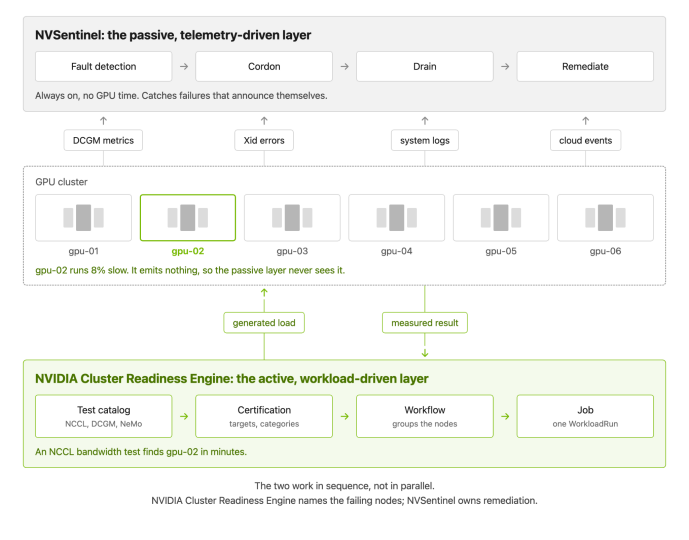
NVIDIA Cluster Readiness Engine (NVCRE) is an open source Kubernetes controller that narrows the search to the specific nodes involved before production workloads land. It runs real distributed workloads across topology-aware node groups, measures the results, and reports which nodes failed each test. Operators no longer need to write NVIDIA Collective Communications Library (NCCL) manifests by hand, bisect racks manually, or learn about degraded hardware from customer tickets.
Readiness becomes a proven property of the cluster rather than an assumption.
A GPU cluster becomes ready in stages. It moves through bring-up, burn-in, preproduction, and production, with each stage setting a different bar. A node that passes a smoke test is not necessarily ready to join a 512-GPU training run.
Platform teams often encode that progression in a runbook, spreadsheet, or shell scripts wrapped around NCCL tests. It becomes another system they must build and maintain alongside node configuration, GPU sharing, and workload orchestration.
A cluster can pass standard diagnostics and still fail under a real distributed job, so the best way to test readiness is to run a workload. On Slurm, that requires a single srun command. Kubernetes has no built-in equivalent, so the same test requires GPU and remote direct memory access (RDMA) resource requests, NCCL settings matched to the network fabric, a large enough shared-memory volume, and a way to ensure that all pods start together.
NVCRE fills these gaps on Kubernetes. It runs workloads that expose real hardware problems and names exactly which node caused each failure.
The API is the product surface. Custom resource definitions (CRDs) define each resource, so you can inspect it with kubectl and manage it through GitOps workflows.
A certification creates one workflow per category, and each workflow creates its child job.
Results then propagate upward. The job records which nodes failed and why, the workflow reports the test result, and the certification groups results by category.
That hierarchy attributes each failure to a specific node and category. For example, a run reports that
Source
NVIDIA · 28 Sep 2026 · 19:14 CEST
Open the original at NVIDIA ↗