Automation & Agents · 28 Sep 2026 · 17:10 CEST
Add Runtime Controls to AI Agents with NVIDIA OpenShell
Publisher preview · OZZZER analysis pending editorial review.
PUBLISHER ARTICLE PREVIEW
From the original article
AI agents can be given a goal, write code, use tools, and keep working as new information becomes available. This opens the door to applications that investigate software failures, run experiments, and carry out business-critical actions and research over days or weeks.
Useful agents need access to workspaces, compute resources, data, credentials, and external services. But broader access also creates more consequential failure modes, from changing production data or exposing confidential information to acting beyond the assigned task.
NVIDIA OpenShell 0.1.0 is an open-source runtime for defining and enforcing which systems and data an agent can access. It combines sandboxed execution, controlled service access, credential management, and formal policy analysis. Teams can grant agents the capabilities a task requires while OpenShell enforces those permissions outside the workload.
It supports Codex, Claude Code, Pi, Hermes, and future frameworks across enterprise applications, frontier research, and physical AI—from internal agent fleets and long-horizon research to robotics and edge systems.
This post shows how NVIDIA OpenShell 0.1.0 places enforceable runtime controls around an existing AI agent—without rewriting it—so teams can restrict API operations, protect credentials, and review permission changes outside the agent workload.
OpenShell provides the runtime layer of the broader NVIDIA Open Agent Safety Platform, which extends protection across the application, runtime, and infrastructure layers.
OpenShell is open source and available for enterprise adoption across a broad ecosystem of partners, which shapes the product itself. Organizations are adopting OpenShell across a range of applications, including chip design, enterprise automation, accelerated computing, and physical AI.
OpenShell 0.1.0 supports sandbox operations, policy verification, governance integration, credential protection, and flexible compute.
An agent can interpret instructions, choose tools, and evolve its approach over time. OpenShell preserves that flexibility while enforcing permissions outside the agent workload.
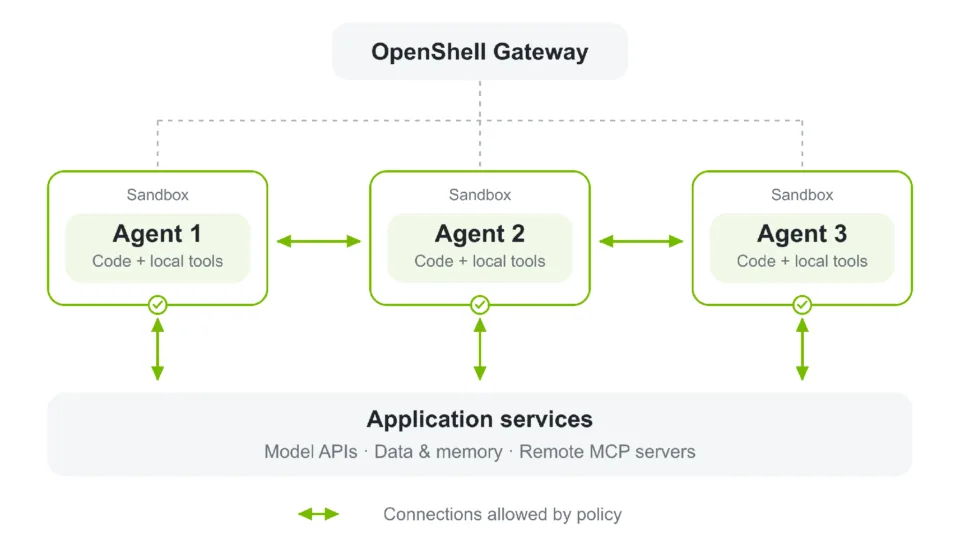
OpenShell can manage fleets of agents and their sandboxes, each with its own permissions, and enable governance across groups at a time. Three components provide this control:
The OpenShell sandbox runtime uses operating-system kernel controls to limit which files a workload can read or change and prevent it from acquiring additional system privileges. For network access, you can be more specific than allowing a connection to a service. The supervisor can inspect configured HTTP, GraphQL, and Model Context Protocol (MCP)
Source
NVIDIA · 28 Sep 2026 · 17:10 CEST
Open the original at NVIDIA ↗