Models & tools · 29 Sep 2026 · 21:10 CEST
AI Native by Design: Lessons Learned from Building NVIDIA TensorRT Model Connect
Publisher preview · OZZZER analysis pending editorial review.
PUBLISHER ARTICLE PREVIEW
From the original article
Parallel work, model family isolation, reversible changes, and GPU-backed validation shaped an open source project designed around coding agents
Parallel work, model-family isolation, reversible changes, and GPU-backed validation shaped an open source project designed around coding agents
NVIDIA TensorRT Model Connect is an open source collection of AI model reference implementations in C++, built on top of NVIDIA TensorRT. It began with a practical question: could the performance of the NVIDIA inference stack be made accessible to model developers who are not TensorRT experts?
The NVIDIA team initially approached the project as an experiment with coding agents. Within the first few days, however, the interest shifted to a larger question: what would it mean to design a serious software project around AI agents from the beginning—not merely use an agent to accelerate an existing development process?
The answer has not been an elaborate orchestration system or an ever-growing collection of prompts. It has been a set of engineering choices:
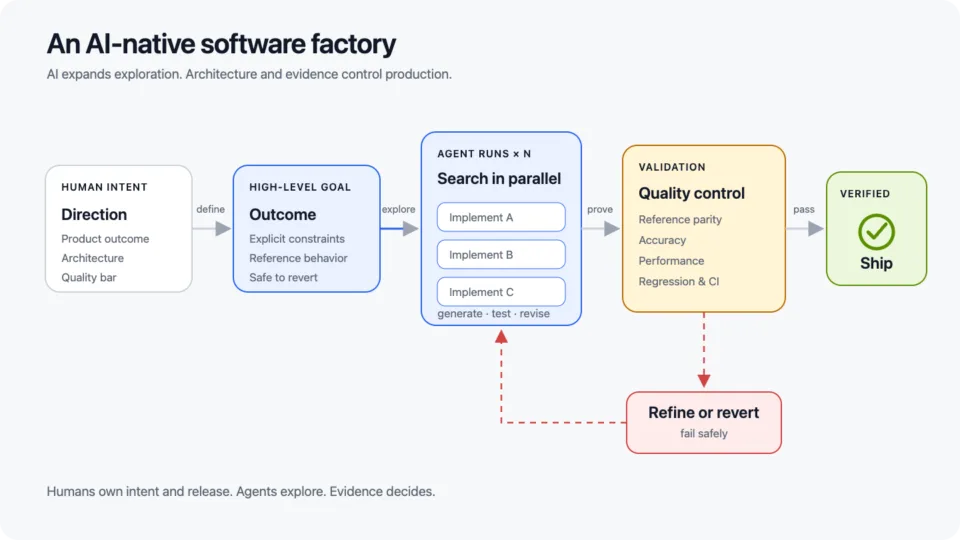
AI increases the rate at which candidate implementations can be produced. Architecture and validation determine whether that increased output becomes reliable software.
AI native can mean many things. In reference to TensorRT Model Connect, the term is used in a narrow, operational sense. AI-native projects treat AI outputs as modular, verifiable units of work. Isolating these units prevents errors from cascading, ensuring that the inherent unpredictability of AI models does not compromise system stability.
This does not mean that AI writes everything. It does not mean that human judgment disappears. And it does not mean that every software project should adopt the same model. Nor does it mean code emitted without supervision; rather, it refers to a production system capable of exploring many candidate changes and subjecting each one to repeatable quality control.
Compute helps create the candidates. Tests, reference comparisons, benchmarks, and human review determine what is ready for shipping.
The following sections explain the lessons learned from building AI-native TensorRT Model Connect.
Some engineering workloads have a long serial critical path. Others comprise many independent workstreams. Adding agents helps far more in the second category.
The long tail of AI models is a natural fit for horizontal work. Model families, configurations, operators, runtime paths, and validation cases can often be investigated independently. Work on one model family does not always need to block work on another.
The project provides family-owned reference implementations that turn supported Hugging
Source
NVIDIA · 29 Sep 2026 · 21:10 CEST
Open the original at NVIDIA ↗