Data & Analytics · 30 Sep 2026 · 21:13 CEST
Expanding AI Storage Access with NVIDIA cuObject and the NVIDIA SCADA Server SDK
Publisher preview · OZZZER analysis pending editorial review.
PUBLISHER ARTICLE PREVIEW
From the original article
AI infrastructure engineers, storage developers, and cloud service providers need fast and secure access to high-capacity file and object storage to support AI workloads.
AI workloads increasingly require high-speed data access for training, fine-tuning, inference context, tool calls, searches, and database lookups. Much of this data lies in files and objects stored both on-premises and in the cloud. Compute accelerators—including GPUs, TPUs, and XPUs—need remote direct memory access (RDMA) that uses NIC- or DPU-accelerated data transfers (like NVIDIA ConnectX NIC or NVIDIA BlueField DPU) and doesn’t copy the data through the server’s CPU-controlled memory.
The need for RDMA-accelerated, zero-copy data transfers grows with faster GPU architectures.
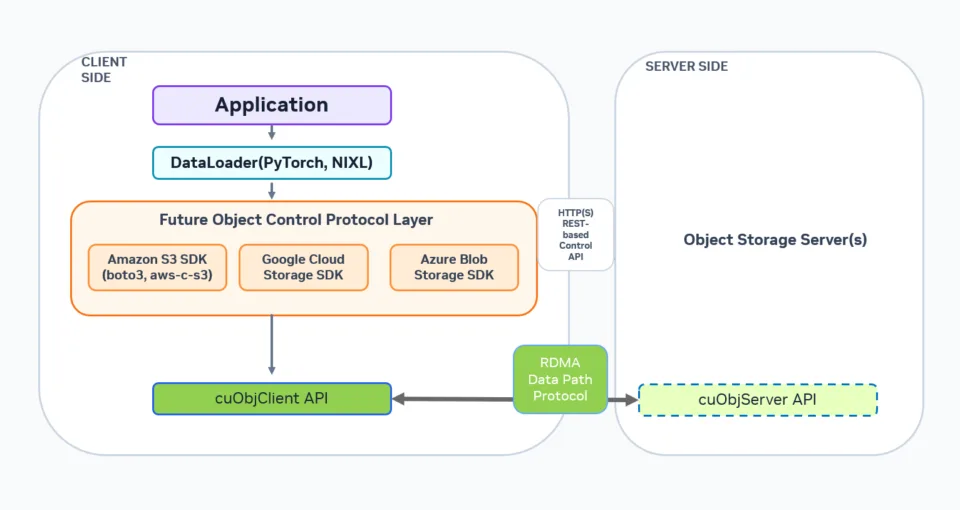
Developers building direct access to file and object storage have had to navigate different APIs and protocols across providers. Object storage over RDMA has also lacked a common wire protocol, leaving developers to support provider-specific integrations or rely on traditional access methods.
The expansion of xio-sig and the new Scaled Accelerated Data Access (SCADA) Server SDK offer two ways to build more interoperable storage access for AI workloads.
NVIDIA is expanding xio-sig to include NVIDIA cuObject alongside cuFile, in partnership with Google Cloud and Microsoft. It is also announcing the general availability of cuObject client and server libraries.
Source
NVIDIA · 30 Sep 2026 · 21:13 CEST
Open the original at NVIDIA ↗