AI Audio · 30 Sep 2026 · 17:21 CEST
Build a multi-agent music production pipeline on Amazon Bedrock AgentCore Runtime Instances
Publisher preview · OZZZER analysis pending editorial review.
PUBLISHER ARTICLE PREVIEW
From the original article
As organizations move from single-purpose agents to multi-agent systems, the infrastructure requirements change. A lone agent handling customer queries can run in a serverless environment with short-lived sessions. But when you need three agents collaborating on a creative workflow that spans several days, sharing context and building on each other’s output, serverless sessions that cap at a few hours don’t cut it.
In this post, we walk through deploying a music production pipeline: One agent runs a generative audio model on the instance’s own GPU. The other two open the .wav file it wrote, off a shared volume. By the end, you will have a track you can play. You will also have learned how to create capacity providers, deploy agents from different artifact types, orchestrate agent-to-agent collaboration using shared sessions, and persist workflows across multiple days.
Amazon Bedrock AgentCore offers two compute options for hosting agents. MicroVMs are the serverless option: fast cold starts, session isolation, and consumption-based pricing. Runtime Instances are the new option: AWS managed EC2 infrastructure for persistent, long-running agent workflows. Both use the same runtime APIs, but Instances add multi-day sessions, GPUs, persistent volumes, and the ability to colocate multiple agents on a single instance.
Both options support custom frameworks (CrewAI, LangGraph, LlamaIndex, Strands Agents), work with your choice of foundation model, integrate with MCP and A2A, and share the same AgentCore runtime APIs. The difference is in the underlying compute model.
An agent is a workload running within a session. Unlike the MicroVM model, where one runtime hosts one agent, a single Instances session can host multiple agents. When two agent runtimes share the same capacity provider, you can invoke them with the same runtimeSessionId to land both agents on the same EC2 instance. There, they share a filesystem and can collaborate on the same task.
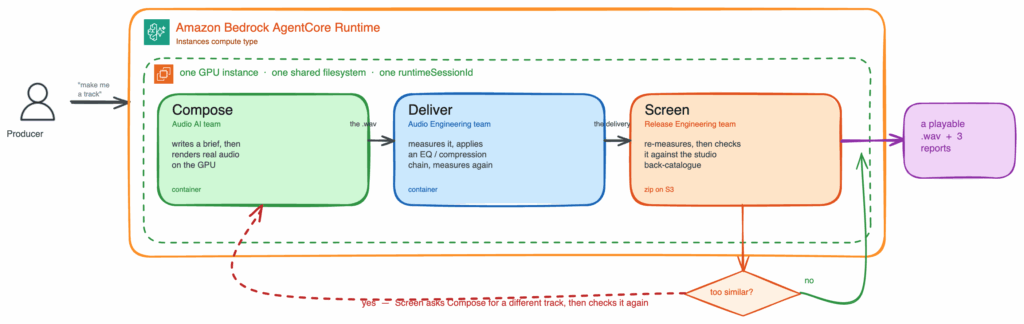
Figure 1: The three-agent pipeline (Compose, Deliver, Screen) sharing one GPU instance and session
We will build a music production system that uses three specialized agents:
The workflow: a producer starts a track. The composition agent writes a brief and renders real audio on the instance’s GPU. The delivery agent opens that file, measures it, applies a chain it derived from those measurements, and measures again to prove the result landed on target. The compliance agent then re-measures independently, checks the delivery targets, and screens the audio against the studio’s back catalog.
If the screen flags a match, it calls back to the composition agent to generate an alternative. The producer ends up with a playable .wav and three reports explaining every decision.
Source
AWS AI · 30 Sep 2026 · 17:21 CEST
Open the original at AWS AI ↗