Business use · 30 Sep 2026 · 17:37 CEST
Query claims in natural language with Amazon Bedrock Knowledge Bases
Publisher preview · OZZZER analysis pending editorial review.
PUBLISHER ARTICLE PREVIEW
From the original article
Claim answers are scattered across adjuster diary entries, repair estimates, police reports, payment ledgers, and scanned attachments rather than one searchable field. A policyholder might ask whether a claim was approved, while an adjuster might need every open auto claim over $10,000 from last month. Both tasks require finding and combining evidence quickly and accurately.
Retrieval Augmented Generation (RAG) uses retrieved documents to ground model responses. Amazon Bedrock Knowledge Bases is the fully managed RAG capability for documents. Amazon Bedrock handles parsing, chunking, embeddings, and vector storage, so you can build a conversational interface that returns cited answers from claim files.
This technical how-to uses synthetic claim records and doesn’t describe a production customer deployment. You build a claims assistant that answers natural-language questions with citations by completing these steps:
Answers are stored in PDF adjuster reports, Word correspondence, and text notes rather than consistent database fields.
Records can conflict or supersede earlier versions. A revised estimate can replace an earlier one, or a provisional payment can be reversed later. The assistant must identify which estimate, payment, or status controls.
Because claims are regulated, every answer must be grounded in source documents and include citations. Contact center agents can verify a source before repeating an answer, and supervisors can audit how the assistant reached it.
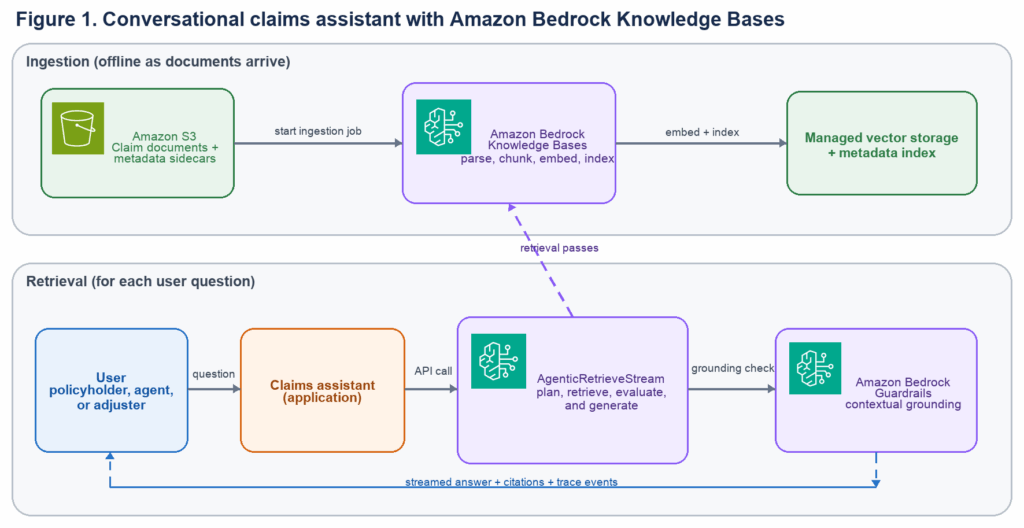
The solution uses Amazon Bedrock Knowledge Bases to index claim documents from Amazon S3 for retrieval.
Agentic retrieval through AgenticRetrieveStream plans an answer, breaks a multi-part question into sub-queries, and runs one or more retrieval passes. It checks whether the evidence is sufficient before generating a response.
The API streams trace events, answer text, and citations. Trace events expose the retrieval plan, and each citation maps part of the answer to a source claim document.
The following diagram shows both paths. The ingestion lane loads claim documents and metadata into a knowledge base. The retrieval lane sends each question through AgenticRetrieveStream and an Amazon Bedrock Guardrails grounding check before returning a cited answer.
Store one document per claim in Amazon S3. The knowledge base reads PDF adjuster reports, Word correspondence, and text notes directly, so you can keep documents in their native format.
Figure 2 shows a synthetic claim record. Current exposure is the estimated total claim cost. Its evidence index identifies a superseded fax draft, meaning a record replaced by a newer version. The metadata sidecar repeats fields that the assistant can filter.
Figure 2: A synthetic claim record with its file-control fields and evidence index
For filtering, add an accompanying metadata file with the same name plus .metadata.json. For CLM-100482.pdf, use CLM-100482.pdf.metadata.json. Subrogation is an insurer’s effort to recover costs from a responsible third party. The following example describes one auto claim:
The sidecar contains scalar string, number, and Boolean values. Value
Source
AWS AI · 30 Sep 2026 · 17:37 CEST
Open the original at AWS AI ↗