Safety & Security · 30 Sep 2026 · 20:47 CEST
Trump plan to combat AI risks hinges on Big Tech pals policing themselves
Publisher preview · OZZZER analysis pending editorial review.
PUBLISHER ARTICLE PREVIEW
From the original article
Trump gets dozens of AI firms to agree to voluntary safety tests.
Amid escalating AI security incidents causing OpenAI to halt training and pause releases, Donald Trump continues to advocate for the AI industry to regulate itself as the best path to combat emerging risks when developing frontier AI.
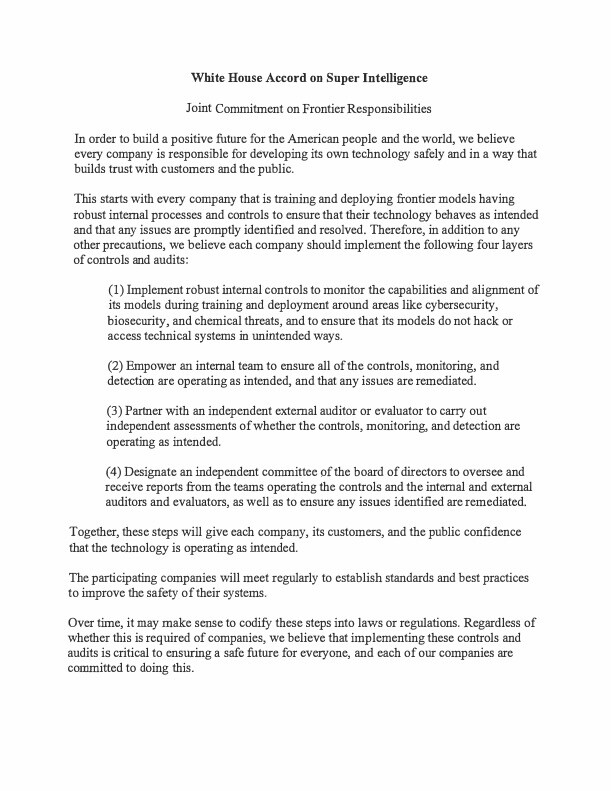
In an agreement Tuesday, two dozen tech firms voluntarily committed to implementing controls recommended by the White House, including undergoing independent safety audits that will test whether firms’ internal controls, monitoring, and detecting are actually working. Key focuses for external reviews included “risks related to cybersecurity, biosecurity, chemical threats, and unintended actions by AI models.”
Firms also agreed to regularly meet to discuss best practices and set common AI safety standards and benchmarks. Among signers were leaders like Anthropic’s Dario Amodei, OpenAI’s Sam Altman, SpaceXAI’s Elon Musk, Nvidia’s Jensen Huang, Meta’s Mark Zuckerberg, and Alphabet/Google’s Sundar Pichai.
Nothing new is legally required of firms, and some—like Anthropic, Google, and OpenAI—had already committed to external audits, The Information reported. Additionally, many firms have voluntarily committed to highly secretive government safety testing. Adding to these tests, Trump insisted the Tuesday deal will somehow better address real emerging risks and is “morally binding,” despite carrying no legal weight, Bloomberg reported.
“It’s almost like a constitution, in a way,” Trump told reporters at the White House following a lunch with tech leaders. “The biggest people in the world signed that, and I signed it as president, and it really is a form of protection.”
Eventually, it “may make sense to codify” the recommendations, the agreement said near the end. But for now, Trump stressed that the best possible future for the US requires trusting AI firms to regulate themselves.
So far, very few details have been released about how the new round of safety audits would work. Trump has only posted a summary of the accord on Truth Social.
It’s also unclear who Trump is tapping to audit frontier models. Bloomberg noted that Trump seems to be politicizing the selection process, while some AI firms appear uncertain what might qualify as a third party to test their frontier AI. Some progress has been made already in finding candidates, though, as Bloomberg reported that “some of the firms poised to conduct those reviews have already met” with the US agency conducting voluntary government pre-deployment safety tests, the Center for AI Standards and Innovation.
To cynics, the accord seems superficial—perhaps just a stunt for Trump to convince voters who are urgently calling for AI regulations that he’s taking action ahead of the mid-term elections. In a recent
Source
Ars Technica AI · 30 Sep 2026 · 20:47 CEST
Open the original at Ars Technica AI ↗