Automation & Agents · 23 Sep 2026 · 20:41 CEST
From portal-hopping to instant answers: HEMA’s journey with MCP and Amazon Bedrock
Publisher preview · OZZZER analysis pending editorial review.
PUBLISHER ARTICLE PREVIEW
From the original article
This post is co-written with Mauro Rallo and Patrick van der Plas from HEMA.
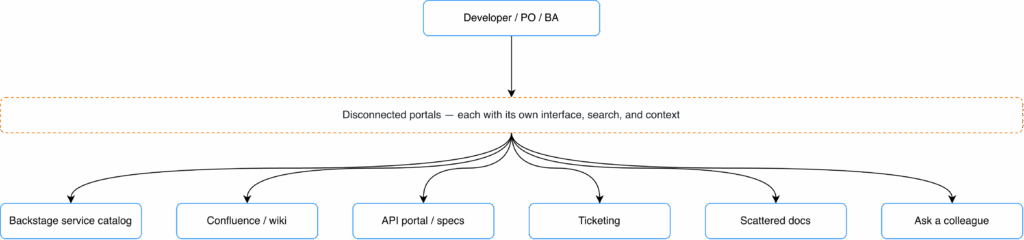
When engineers at HEMA needed an answer, they went portal-hopping, navigating disconnected wikis, service catalogs, and IT portals to find it. To turn that friction into instant answers, the 100-year-old Dutch retailer built a knowledge layer on Amazon Bedrock AgentCore. HEMA has over 750 stores across multiple countries, served by a technology organization of engineers, product owners, and business analysts driving digital transformation.
It needed a solution that worked across roles and tools.
Over the years, HEMA had quietly built something valuable: a large, structured picture of its own technology landscape. A service catalog mapped people to teams, teams to services, and services to the APIs we expose, and the business capabilities we support. The problem was never that the knowledge didn’t exist. It was that the knowledge was hard to reach.
As the engineering organization grew, the informal “just ask the person next to you” model broke down, and teams ended up scattering answers across portals, wikis, and documentation that few people knew how to navigate.
In this post, we describe the challenge HEMA faced with fragmented internal knowledge, why we chose to build HAL, HEMA’s internal AI assistant, using Model Context Protocol (MCP) and Amazon Bedrock AgentCore, and how it changed the way our teams work.
The idea rests on two complementary goals. HAL puts knowledge in one place, and MCP delivers that knowledge inside the tools people already use (the HAL chat, Kiro, Claude, and other agents). Security is anchored in Microsoft Entra ID, with no AWS credentials on the client. What began as a developer tool is already a cross-role assistant.
The same architecture will be the foundation for a next step: turning HAL from a read-only knowledge layer into an action layer.
The first layer, structured infrastructure knowledge, was actually in good shape. For years, HEMA has maintained a service catalog that captured how the technology estate fits together: which teams own which services, what APIs those services expose, and how they map to business capabilities. Structured data from systems such as the product information management (PIM) engine and the data-mesh tables had been imported and organized.
For anything about what exists and who owns it, the answer was usually available, if you knew where to look.
The second layer was the gap. Knowing what exists is not the same as knowing how to do something. “How do I request access to an API? How do I get a new group provisioned? What’s our rule for X?”. These procedural questions had no single home. When teams were small and everyone knew each other, that was fine.
People asked directly. As HEMA grew and onboarded new engineers, that model stopped scaling, and there was little written documentation to fall back on.
That translated into slow onboarding for new joiners, inconsistent answers depending on where someone looked, constant context-switching, and friction that pulled people out of their actual work. Finding an answer that once meant navigating three or four portals, sometimes across an entire afternoon, now happens in seconds, from inside the Integrated Development Environment (IDE) or chat window.
Figure 1: The “before” state, showing the sources a user had to consult
Two goals shaped the solution, and they map cleanly onto the two technologies we chose.
The first goal belongs to HAL: consolidate HEMA’s fragmented knowledge into one governed source of truth. The second goal belongs to MCP: deliver that knowledge to people where they already work, rather than forcing them to visit yet another portal.
Why MCP: Model Context Protocol gives us a standardized interface between AI clients and backend capabilities.
Source
AWS AI · 23 Sep 2026 · 20:41 CEST
Open the original at AWS AI ↗