Models & tools · 29 Sep 2026 · 18:14 CEST
Building an AI-powered contract intelligence platform with Amazon Quick and Amazon Bedrock AgentCore
Publisher preview · OZZZER analysis pending editorial review.
PUBLISHER ARTICLE PREVIEW
From the original article
You’re a director of contracting, responsible for hundreds, maybe thousands, of vendor contracts. Each one is packed with critical data: contract values, expiration dates, signing status, and key contacts. With that information locked inside PDFs, you and your team spend hours manually extracting it, maintaining spreadsheets, and fielding the same recurring questions: “Which vendor are we spending the most with?” or “Which contracts are about to expire?”
So you turn to AI chat tools and enterprise Q&A solutions. You upload a contract, ask questions in natural language, and for a single document, or even a handful, it genuinely works well. The real challenge shows up at scale, across hundreds of contracts.
Most of these tools rely on a technique called Retrieval Augmented Generation (RAG). RAG breaks long text into chunks and indexes each one individually. During a search, RAG retrieves only the top-k chunks of text most relevant to a question, an approach more widely known as semantic search. That’s fine when the answer lives in one place.
But when a question spans every contract, like total exposure or upcoming renewals, semantic search falls short. The answer requires aggregation across the full dataset, not only a handful of chunks. A better prompt won’t fix this. A different architecture will.
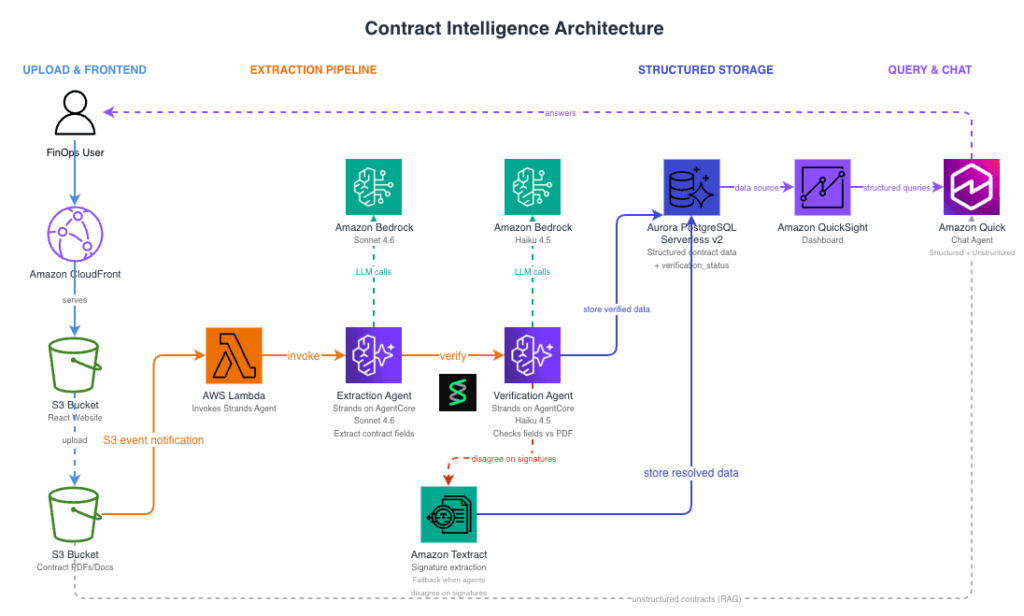
In this post, we share the architecture behind a contract intelligence platform on AWS. It extracts contract data with AI agents, verifies accuracy with a multi-model approach, and delivers instant answers through embedded analytics and natural language querying. Everything runs from a single web application.
Say your portfolio holds 250 vendor contracts, and leadership keeps asking the same four questions:
These are basic questions, but the answers are buried. Each of your 250 contracts runs 10–20 pages, so that’s up to 5,000 pages of unstructured data. To answer those questions, an analyst opens each PDF, searches for the fields that matter, and copies the values into a spreadsheet, then repeats the process 250 times. That’s more than a week of effort to clear the backlog, before a single new contract arrives.
Every follow-up question from leadership means another round of filtering and analysis. Each round risks working from stale data or breaking hardcoded formulas on the new data.
So you upload the portfolio to one of the leading AI chat tools and ask for the total value. The answer comes back fast, confident, and wrong.
That wrong answer wasn’t a fluke. It’s baked into how these tools are built. Internally they chunk each document into vectors and store them in a knowledge base. When you ask a question, they pull back the top-k chunks that best match it, then build an answer using only those chunks as context.
For a targeted lookup, that’s exactly what you want. Ask “What are the payment terms in the AnyCompany contract?” and the right chunk surfaces with a clean answer. A portfolio question works against that mechanism instead of with it. When you ask, “What’s the total contract value across all 250 contracts?”, the system still returns only the top-k chunks and totals only those.
It can’t sum, count, or compare across the portfolio because the portfolio never lands in front of the model. It isn’t a flaw in any one tool but in how RAG itself
Source
AWS AI · 29 Sep 2026 · 18:14 CEST
Open the original at AWS AI ↗