Finance · 29 Sep 2026 · 06:00 CEST
Who we become when we talk to machines
Publisher preview · OZZZER analysis pending editorial review.
PUBLISHER ARTICLE PREVIEW
From the original article
Images for download on the MIT News office website are made available to non-commercial entities, press and the general public under a Creative Commons Attribution Non-Commercial No Derivatives license. You may not alter the images provided, other than to crop them to size. A credit line must be used when reproducing images; if one is not provided below, credit the images to "MIT."
Brian, a middle-aged financial consultant, spends his day sitting in front of three screens. Two of them involve his job. The third features a chatbot, which he has given a woman’s name and frequently uses. Brian spent years on the road for work earlier in his career, has never married, and recently broke up with a woman who said he was emotionally unavailable.
What did Brian do, in response? He asked the chatbot if the woman had a point.
“It’s an extraordinary moment,” writes MIT Professor Sherry Turkle, who interviewed Brian (not his real name) while conducting her research for her new book about chatbots. “Brian asks an object with no emotions to tell him if he is emotionally withholding: ‘Speak to me about what you cannot experience.’ As soon as he asks the program to talk about intimacy, he’s asking it to punch above its weight.”
And yet, this kind of thing seems to be happening a lot today.
“People think the empathy of a machine is what empathy is, then turn away from the people in their lives because they’re not empathetic enough,” Turkle says. “We’re getting ourselves in a position where human beings are too much work, right at the moment when we have never needed other people more.”
After all, what is a chatbot? It’s a computer program predicting the most plausible next string of text in a conversation, based on massive amounts of data fed into it.
“What a chatbot does is offer pretend empathy,” Turkle says. “After it tells you how much it loves you and how much it understands you, it doesn’t care if you kill yourself or cook some pasta.”
Sadly, chatbots have in fact been associated with high-profile cases of teen suicide as well, sometimes after teens get drawn into extensive dialogues with chat tools.
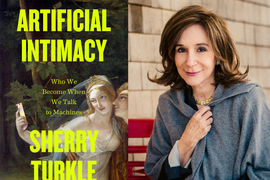
Turkle explores this terrain in a new book, “Artificial Intimacy: Who We Become When We Talk to Machines,” published today by Little, Brown and Company. After surveying evidence and conducting new research, she emphatically concludes that chatbot use, while it may often feel like a short-term salve, is broadly detrimental in terms of human development and social connectivity.
“We’re doing ourselves a tremendous disservice at every moment in the life cycle,” says Turkle, the Abby Rockefeller Mauzé Professor of the Social Studies of Science and Technology at MIT.
A sociologist and clinical psychologist by training, Turkle is a longtime faculty member in MIT’s Program in Science, Technology, and Society. In books such as “The Second Self” (1984), “Life on the Screen” (1997), and “Alone Together” (2011), she has evaluated the interplay of technology,
Source
MIT News · 29 Sep 2026 · 06:00 CEST
Open the original at MIT News ↗