Research · 17 Jun 2026 · 02:00 CEST
Introducing LifeSciBench
Publisher preview · OZZZER analysis pending editorial review.
PUBLISHER ARTICLE PREVIEW
From the original article
Agentic AI systems are becoming increasingly capable of performing scientific tasks. However, their usefulness to life science researchers depends on how well they handle the complexity of real research. That work rarely looks like a single fact-recall question or a clean prediction problem. Researchers interpret incomplete evidence, reconcile conflicting results, design difficult experiments, troubleshoot assays, evaluate translational risk, and decide what to do next under uncertainty.
Current benchmarks do not fully capture these capabilities. Many life science evaluations focus on narrow domains or isolated skills, resulting in questions with structured question formats and clean reference answers. While valuable, they often fail to truly assess whether a model can contribute across the broader span of research-level work.
We designed LifeSciBench to help close this gap. Every task is grounded in the judgment of practicing life scientists with Ph.D.-level training and direct experience advancing drug discovery programs in biotech and pharmaceutical settings.
LifeSciBench measures whether AI systems can support realistic life science research tasks, not just answer biology questions. To define the benchmark taxonomy, we surveyed practicing life scientists about the workflows they use most often in applied research settings. Then, we grouped their responses into seven recurring categories: evidence handling, analysis, design and optimization, scientific reasoning, validation and operations, translation, and scientific communication.
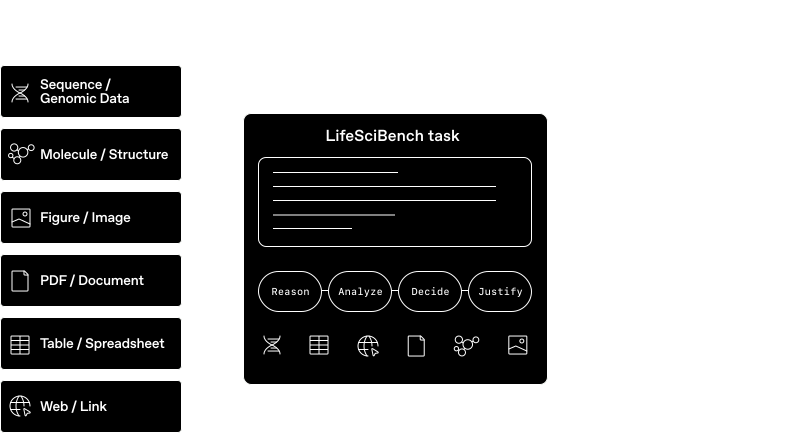
Each task is structured like a request a scientist might give to a knowledgeable collaborator: scientific prompt, any relevant context or artifacts, and a free-response answer. Expert-written rubrics evaluate whether a model can produce the right answer for a specific problem, with the right level of detail, justification, caveats, and formatting a scientist would expect.
LifeSciBench evaluates scientific reasoning alongside the less well-defined, practical skills necessary for real-world scientific use. Its tasks ask models to work through realistic research problems: interpreting evidence, making domain-grounded judgments, and communicating conclusions that would be useful to expert reviewers. Many tasks also require models to handle uncertainty and reason over supporting data files rather than relying on prompt text alone.
The benchmark is designed to reflect the complexity of life science work. Overall, 79% of tasks require multiple reasoning or decision-making steps, with an average of four steps per task. LifeSciBench includes 1,062 attached artifacts spanning figures, PDFs, tables, sequence files, structure or chemical files, and web references. More than half of tasks (53%) require models to interpret or synthesize information from at least one artifact.
Tasks were created by 173 expert scientists across different life science disciplines. Each scientist had Ph.D.-level training and biotechnology or pharmaceutical industry experience. Tasks could undergo as many revision cycles as needed before acceptance, with no fixed cap on the number of rounds; accepted tasks averaged six self-directed automated review cycles and completed at least two rounds of expert reviews.
Reviews were anchored in either a verifiable correct answer
Source
OpenAI · 17 Jun 2026 · 02:00 CEST
Open the original at OpenAI ↗