Models & tools · 18 Jun 2026 · 10:00 CEST
Using AI to help physicians diagnose rare genetic diseases affecting children
Publisher preview · OZZZER analysis pending editorial review.
PUBLISHER ARTICLE PREVIEW
From the original article
In an NEJM AI study, experts used an OpenAI reasoning model to reanalyze 376 previously unsolved cases and surface leads for 18 diagnoses.
Even with genomic sequencing, many people with rare diseases never receive a clear genetic diagnosis. Roughly half remain undiagnosed after extensive testing and specialist review. Their medical data may contain clues but finding them can require sifting through thousands to millions of possible genetic variants, fragmented clinical records, and rapidly changing scientific literature.
As new gene-disease relationships, case reports, and classification evidence accumulate, unsolved cases can become newly interpretable.
Researchers from Boston Children’s Hospital’s Manton Center for Orphan Disease Research, Harvard University, and OpenAI used the OpenAI o3 Deep Research reasoning model to analyze de-identified clinical and genomic information from 376 previously analyzed cases that remained unsolved. The model surfaced evidence-linked candidate explanations for researchers and clinicians to review. Following expert review, additional testing, and clinical confirmation, physicians established diagnoses in 18 cases—an additional diagnostic yield of 4.8% after earlier analysis by specialists.
This study was published on June 18, 2026, in NEJM AI and shows how an AI-assisted research workflow can help experts generate leads when revisiting some of the most difficult cases.
Many of these cases had evaded years of expert analysis. In this study, OpenAI o3 Deep Research helped researchers identify leads that were later assessed through established clinical processes, suggesting that expert-led periodic reanalysis could become more scalable as knowledge evolves. The model did not diagnose any patient or make any clinical decision. It produced evidence-linked hypotheses for specialists to review and, where appropriate, investigate through additional testing and confirm in a clinical laboratory.
An inconclusive genetic test is not always a permanent finding. A patient’s phenotype descriptions, test results, and family history can be split across databases that use different identifiers, formats, and vocabularies. Linking those records is difficult, so even specialists can miss a diagnosis. Experts may also sequence a child’s genome before a relevant gene or its variants have been linked to disease.
As scientific knowledge advances, the same data can reveal answers that were previously impossible to uncover.
Rare-disease reanalysis is both a scientific and a maintenance problem. The patient’s genome may stay the same, but the evidence around it keeps changing: researchers link new genes and variants to disease, labs reclassify old variants, and case databases and papers accumulate new observations. Each update can make an old inconclusive case worth revisiting, so many institutions inherit a growing backlog of genomes to keep in sync with a moving knowledge base.
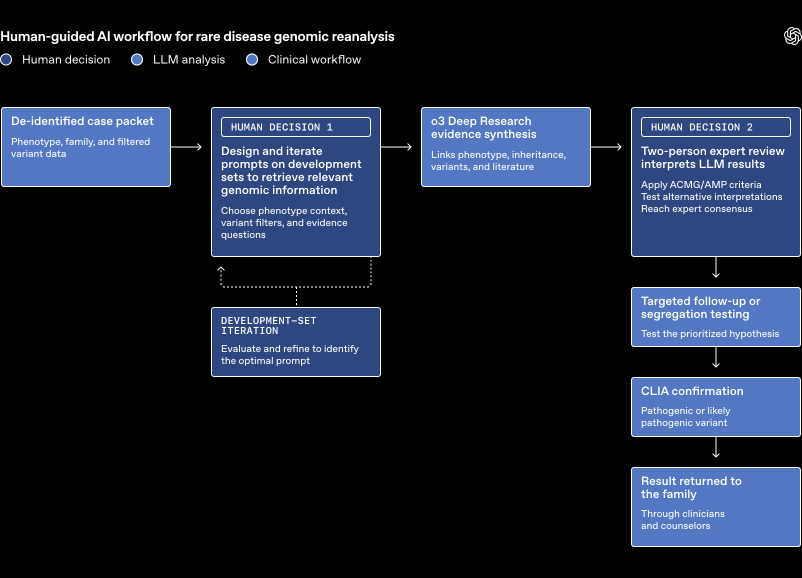
In this study, researchers designed the workflow so that the model acted as an explanation-first reasoning layer on top of existing genomic pipelines. Instead of returning only a ranked gene, it was asked to connect the clinical features, inheritance pattern, variant evidence, and scientific literature into a justification that a human reviewer could interrogate.
For each case, the team assembled a de-identified packet containing standardized Human Phenotype Ontology terms to describe the patient’s clinical presentation, occasional clinician notes and any descriptive clinical diagnosis, metadata such as age and gender, and a filtered variant table. The table captured each variant’s rarity, its predicted effect on the encoded protein, ClinVar classification, and signal quality across available family members.
Most cases included data from the child and both biological parents.
The team asked the model to propose the most plausible molecular explanation and to show its work. Researchers then reviewed the outputs using the same ACMG/AMP framework that clinical labs use to classify genetic variants. At least two team members reviewed each candidate, disagreements were resolved by consensus, and a model output was never treated as a diagnosis.
A finding counted as a
Source
OpenAI · 18 Jun 2026 · 10:00 CEST
Open the original at OpenAI ↗