Unclassified · 9 Jul 2026 · 17:50 CEST
Tiny robot boats build floating structures
Publisher preview · OZZZER analysis pending editorial review.
PUBLISHER ARTICLE PREVIEW
From the original article
Most people think of the waterfront as the edge of the city. A team of MIT researchers sees it as a dynamic, Lego-like construction site.
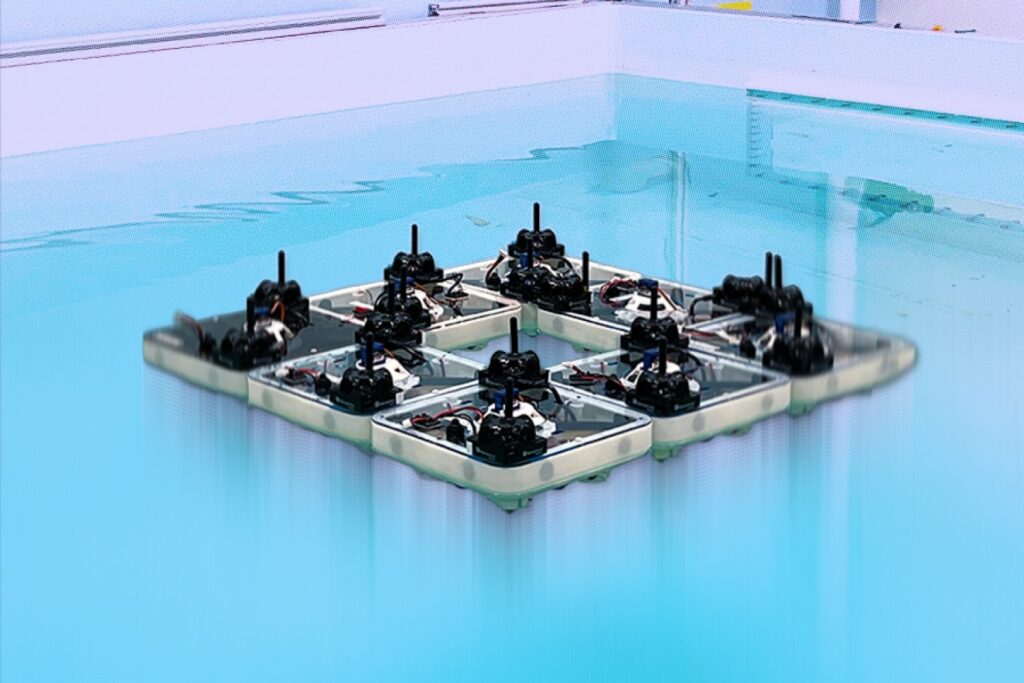
Their new system, called “FloatForm,” is a swarm of small square robotic boats that assemble themselves into larger structures on the water, break apart, and reassemble into something new, all with minimal human direction.
Each robot, about the size of a dinner plate at 21 centimeters square, is a self-contained vessel with its own thrusters, sensors, and magnetic latches. Together, they hint at a future in which floating infrastructure could become more adaptive: a temporary platform after an emergency, a market on a canal, or a stage that appears for a festival and dissolves when the crowd goes home.
“Our FloatForm projects envisions a future where the waterfront becomes a programmable extension of the city, where autonomous boats can self-organize into bridges, platforms, and other useful structures on demand,” says Daniela Rus, the Panasonic Professor of Electrical Engineering and Computer Science at MIT and director of MIT’s Computer Science and Artificial Intelligence Laboratory (CSAIL). “This kind of distributed robotics opens new possibilities for mobility, emergency response, public space, and infrastructure on water.”
“With FloatForm, we are essentially turning static water surfaces into dynamic, programmable spaces,” says Wei Wang, lead author of a new paper on the project and a former MIT research scientist who now leads the Marine Robotics Lab at the University of Wisconsin at Madison. “Imagine an urban environment where public space isn’t fixed, but can autonomously expand, contract, or reconfigure on demand.”
“We see it as forming infrastructure on the water, using a modular system to create one larger system,” says Alejandro Gonzalez-Garcia, a former researcher with MIT CSAIL and the Senseable City Lab. “If there’s an emergency, you could form a new bridge to alleviate traffic in the city. Or you could create floating markets and floating stages.
If you want a more livable city, you want to use the water, too.”
The open-access work, published today in Nature Communications, comes from the labs of Rus and Carlo Ratti, professor of practice of urban technologies and planning at MIT and director of the Senseable City Lab, and grows out of Roboat, their joint project with the Amsterdam Institute for Advanced Metropolitan Solutions that put full-size autonomous vessels on Amsterdam’s canals.
Those canals once carried the city’s goods; today, they mostly carry tourists.
“We explored whether the canals could be used for waste collection, or for transport, to offload some of the stress on the roads back onto the water,” says Niklas Hagemann, an MIT graduate student in architecture, CSAIL affiliate, and former Senseable City Lab researcher who has worked on the project since its early stages. “Urban areas are getting denser, so could you expand public space onto water that’s currently underutilized?”
FloatForm shrinks that vision down to tabletop scale to answer a harder question: How do you get dozens, and eventually thousands, of floating robots to organize themselves?
The team found its answer in biology. Fire ants famously survive floods
Source
MIT News · 9 Jul 2026 · 17:50 CEST
Open the original at MIT News ↗