Models & tools · 10 Aug 2026 · 21:25 CEST
With a feel for physics, AI models simulate a wider range of real-world scenarios
Publisher preview · OZZZER analysis pending editorial review.
PUBLISHER ARTICLE PREVIEW
From the original article
Artificial intelligence models are jacks of many trades, including writing, generating images, and creating 3D models. But they aren’t as helpful when it comes to testing robots or designs for vehicles in diverse environments, since they don’t understand physics as well as they do pixels or text.
To build an AI system that can reliably simulate a variety of physical scenarios, engineers need a range of physics data at a scale that isn’t yet feasible. That’s because it’s very time-consuming to get neural networks just a few data points they can understand. They rely on algorithms called “numerical solvers” to calculate physical properties at different points of a 3D shape.
It’s a thorough process, but it takes so long that it limits how much data you’ll have to, say, test if your plane designs are safe and aerodynamic.A new pre-training approach known as “GeoPT,” developed by researchers at MIT’s Computer Science and Artificial Intelligence Laboratory (CSAIL) and Tsinghua University, gives simulation models a chance to learn physics in a broader, more efficient way.
It virtually reenacts everyday mechanical interactions in 3D, showing how particles stop when reaching some part of an object. These simulations give the models a sense of how physics works, helping them model the real world more accurately, reach peak performance twice as fast, and train on up to 60 percent less data compared to leading models.
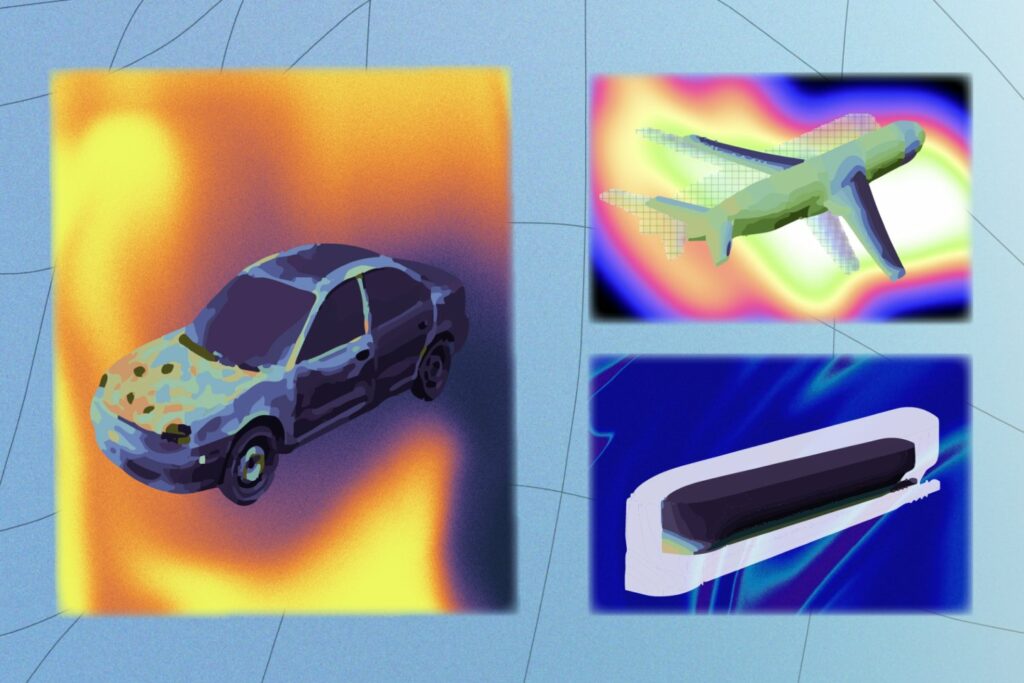
Soon, the project could help engineers predict how vehicles (like cars and planes), everyday items (including chairs and containers), and robots respond to various physical elements, such as wind, water, and collisions. The researchers believe their work could also be a step toward a physics foundation model, a backbone system trained on lots of data that can help AI tools generalize to different tasks.
“We believe physics is the third modality for AI models, after text and pixels,” says MIT PhD student and CSAIL researcher Minghao Guo, a co-lead author
Source
MIT News · 10 Aug 2026 · 21:25 CEST
Open the original at MIT News ↗