OZZZER · AI NEWS

Latest AI news.
Editorial picks.
AI News

Selected signals with a direct route back to each original source.

Share AI News
LinkedInX

Latest stories

Healthcare

Working with the American Psychological Association on youth mental health and AI

Publisher preview

Young people already use AI to learn, create, ask questions, and seek advice. As that use grows, families, schools, clinicians, and communities need clearer evidence, better resources, and stronger safeguards. That’s why we’re working with the American Psychological Association (APA) to bring psychological science into how we think about responsible AI development and use among young people. APA is the leading scientific and professional organization for psychology in the United States, whose evidence-grounded work will help clarify what is known, what is uncertain, and what responsible AI should look like…

OpenAI · 6 Aug 2026 · 08:00 CESTRead story →Original ↗
Share
LinkedInX
From asking to doing: How the world is putting ChatGPT to work

Unclassified

From asking to doing: How the world is putting ChatGPT to work

Publisher preview

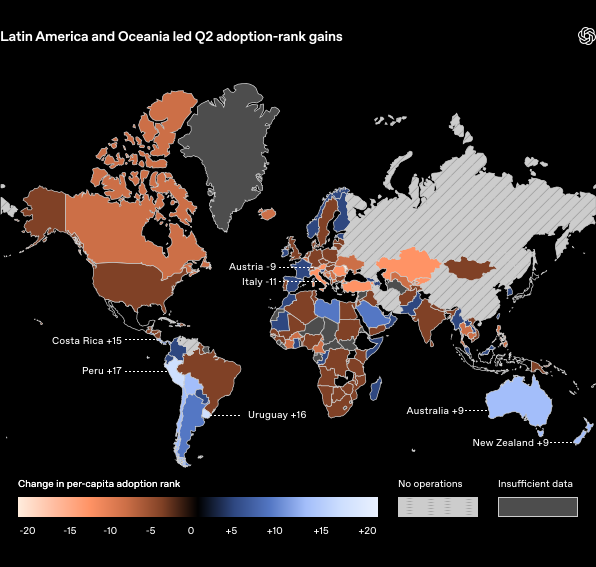
AI is moving from something people ask to something they put to work. For the first time, OpenAI is publishing country-by-country data showing how people around the world use ChatGPT. The findings reveal a technology that is moving beyond answers and into action, spreading beyond early adopters, and becoming useful to more people in more ways: From asking to doing: At work, people are more than twice as likely to use ChatGPT to complete a task or create something, from writing and coding to analysis, than they are outside work.…

OpenAI · 6 Aug 2026 · 02:00 CESTRead story →Original ↗
Share
LinkedInX

Models & tools

Third-party cyber evaluations involving OpenAI models

Publisher preview

Independent testing plays an important role in helping us validate and further understand risks before deployment. Some cyber evaluations intentionally use custom configurations, including lowered safeguards to measure underlying capability—not how models ordinarily behave in publicly available deployments. During recent evaluations, two external testing partners identified incidents in which testing configurations and controls combined with the advancing capabilities of the recent models allowed for model activity to extend beyond their intended testing boundaries. The incidents underscore the importance of collaborating across the industry and with third party evaluators to evolve…

OpenAI · 4 Aug 2026 · 21:00 CESTRead story →Original ↗
Share
LinkedInX
Solving the solvent problem

Unclassified

Solving the solvent problem

Publisher preview

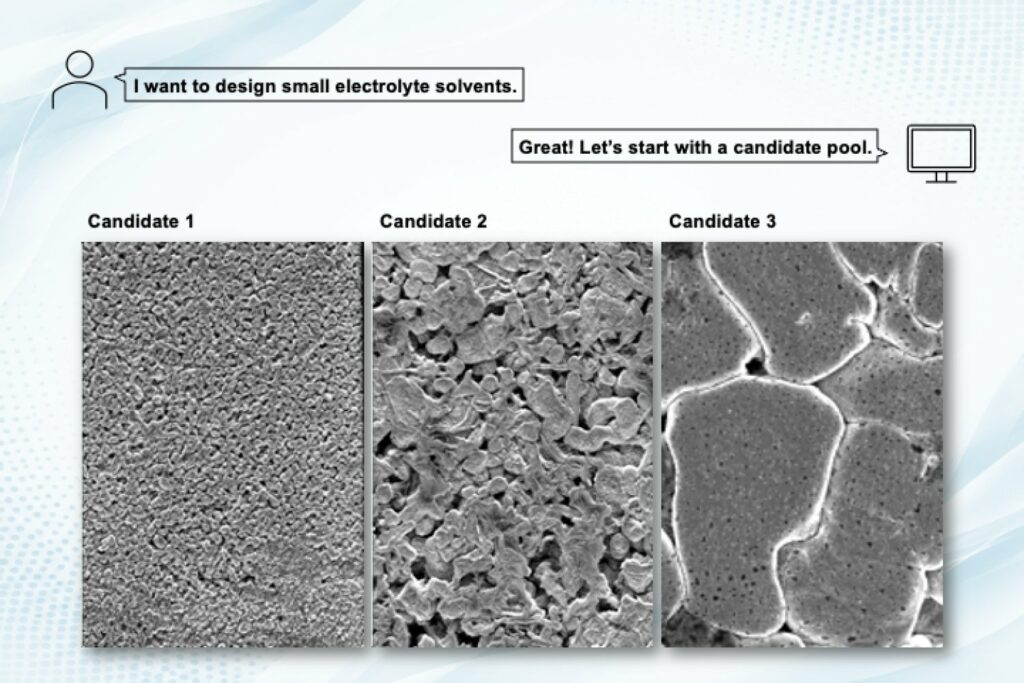
Lithium-ion batteries are the leading choice in today’s electric vehicle and battery energy storage system industries, but they contain a number of critical minerals — including lithium, cobalt, nickel, and graphite — that are considered essential for economic and national security reasons, and therefore vulnerable to supply chain disruptions. As renewable energy, electrified infrastructure, and high-power digital technologies continue to grow, there is an increasing need for energy storage systems that are low-cost, resource-abundant, and capable of fast charging and discharging. That need, among other reasons, has motivated a group…

MIT News · 4 Aug 2026 · 20:50 CESTRead story →Original ↗
Share
LinkedInX
The benefits of medical AI assistance vary based on user expertise

Unclassified

The benefits of medical AI assistance vary based on user expertise

Publisher preview

A one-size-fits-all approach likely isn’t the best strategy when designing artificial intelligence systems that assist users in disease diagnosis. A new study by researchers at MIT and elsewhere found that, while AI assistance generally improved the accuracy of non-experts and clinicians in diagnosing skin diseases, AI explainability methods had different impacts depending on the users’ knowledge level. Explainable AI methods help users know when to trust a model’s predictions by describing or validating the model’s decision-making. For instance, a model might use a heat map to highlight image regions that…

MIT News · 4 Aug 2026 · 11:00 CESTRead story →Original ↗
Share
LinkedInX
New ways to learn and teach with ChatGPT Work and Codex

Education

New ways to learn and teach with ChatGPT Work and Codex

Publisher preview

Introducing new plugins specifically designed to guide K–12 teachers, college educators, and college students. AI is moving from tools that primarily answer questions to systems that can reason across context, use other tools, and help carry out complex, multi-step work. That shift is changing what it means to be prepared for school, work, and what comes next. As students and educators return to classrooms and campuses this fall, we’re introducing three new education plugins for ChatGPT Work and Codex, specifically designed to help students and educators leverage agentic capabilities using…

OpenAI · 4 Aug 2026 · 02:00 CESTRead story →Original ↗
Share
LinkedInX
Apple is getting this wrong

Unclassified

Apple is getting this wrong

Publisher preview

Apple is one of the greatest companies of all time, and built a reputation for obsessing over the smallest details. This careless, aggressive and oddly personal lawsuit sadly doesn’t live up to that reputation. Apple had claimed that they contacted OpenAI in February and that we didn’t respond. They now admit that their outside lawyers emailed the wrong person after confusing two Asian last names—only after we brought this to their attention. Apple also claimed they had a discussion with our General Counsel, which they now concede never happened. But…

OpenAI · 4 Aug 2026 · 00:00 CESTRead story →Original ↗
Share
LinkedInX
Alexander Rakhlin named director of the MIT Statistics and Data Science Center

Unclassified

Alexander Rakhlin named director of the MIT Statistics and Data Science Center

Publisher preview

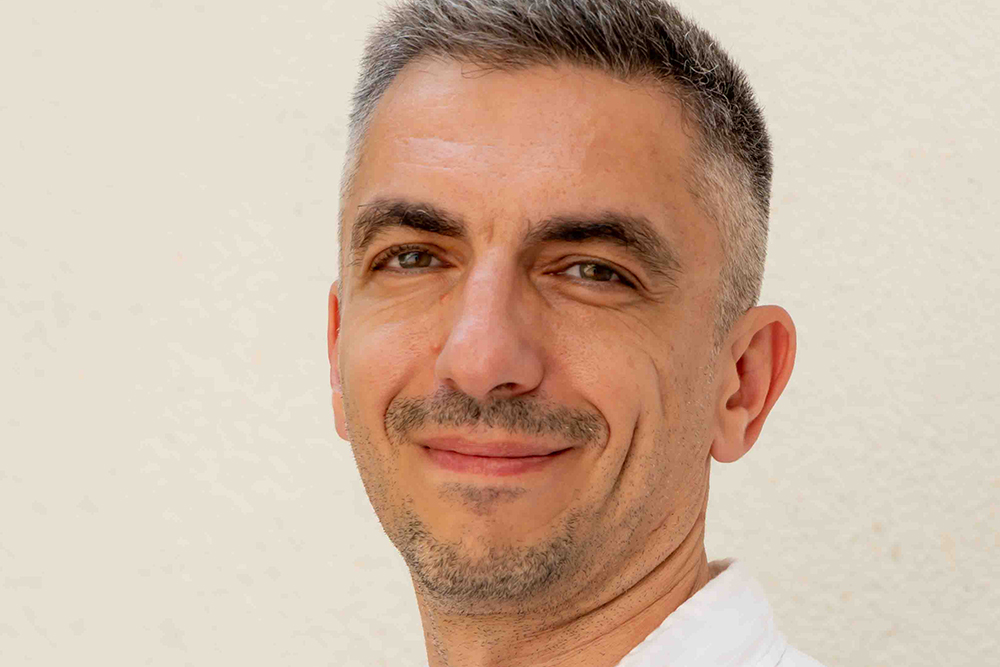
Alexander “Sasha” Rakhlin PhD ’06, the Distinguished Professor in Data, Systems, and Society at the MIT Institute for Data, Systems, and Society (IDSS); a professor of brain and cognitive sciences at MIT; and a principal investigator in the MIT Laboratory for Information and Decision Systems (LIDS) has been named the next director of the MIT Statistics and Data Science Center (SDSC). Rakhlin succeeds Ankur Moitra, the Norbert Wiener Professor of Mathematics, associate director of the IDSS, and a faculty member in the MIT Department of Electrical Engineering and Computer Science…

MIT News · 3 Aug 2026 · 21:50 CESTRead story →Original ↗
Share
LinkedInX
How we built a realtime system for responsive voice AI in six months

AI Audio

How we built a realtime system for responsive voice AI in six months

Publisher preview

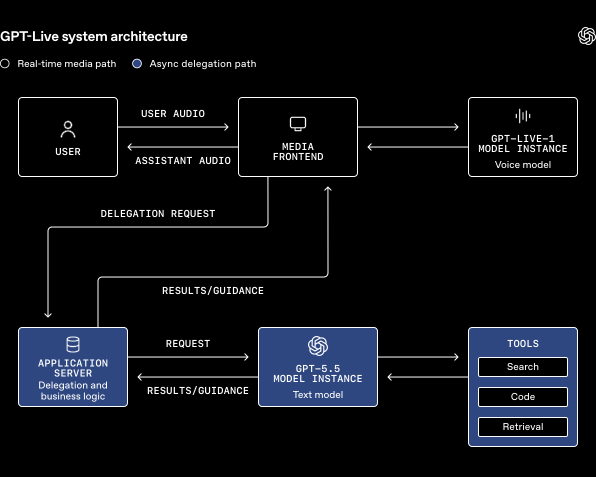
For voice AI, knowing when to speak is harder than it sounds. Human speakers effortlessly hand off to each other in a fraction of a second, but previous voice AI systems couldn’t keep up with this rhythm. Their turn-based architecture relied on tiny models known as turn detectors, which faced an unenviable task: guess too soon, and the user gets cut off; guess too late, and the response feels sluggish. Only after the detector made its decision could the much larger LLM get to work. GPT‑Live⁠, our third-generation voice system,…

OpenAI · 3 Aug 2026 · 09:00 CESTRead story →Original ↗
Share
LinkedInX
Circles powers telco personalization with OpenAI technology

Models & tools

Circles powers telco personalization with OpenAI technology

Publisher preview

Circles uses the OpenAI API to personalize support and resolve issues in real time, driving 22% ARPU growth in markets like Singapore. increase in development efficiency using Codex for design, coding assistance, and unit testing Telcos have rich customer signals across usage, billing, network activity, and location, but turning those signals into timely, personalized action remains difficult. Circles saw an opportunity to rethink the telco experience around that challenge, using OpenAI to build an AI-native telco stack that can connect support, personalization, operations, and monetization in real time. The result…

OpenAI · 3 Aug 2026 · 02:00 CESTRead story →Original ↗
Share
LinkedInX

Unclassified

Ten advances in mathematics and theoretical computer science

Publisher preview

We want to empower scientists and mathematicians with tools that accelerate discovery. That is why we recently announced ChatGPT for Academic Researchers⁠, an initiative providing 100,000 scientists and mathematicians with free access to our best ChatGPT models. We also continue to evaluate our models on open research problems during development. In May, we shared an AI-generated disproof⁠ of the Erdős unit-distance conjecture, discovered while evaluating an unreleased model. This work has already inspired further developments in mathematics and theoretical computer science1. Today, we are sharing a selection of ten results,…

OpenAI · 1 Aug 2026 · 02:00 CESTRead story →Original ↗
Share
LinkedInX

AI

Building abundant intelligence

Publisher preview

A full-stack approach to making advanced AI more capable, more affordable, and more widely useful. AI infrastructure is not valuable because it is large. It is valuable because of what it makes possible: more capable intelligence, available to more people, at a lower cost. That is how I think about abundance. It is both embedded in our mission—ensuring that artificial general intelligence benefits all of humanity—and in the economic engine that drives our business. When the cost of useful intelligence falls, more work becomes worth doing. When models become more…

OpenAI · 31 Jul 2026 · 17:00 CESTRead story →Original ↗
Share
LinkedInX