OZZZER · AI NEWS

Latest AI news.
Editorial picks.
AI News

Selected signals with a direct route back to each original source.

Share AI News
LinkedInX

Latest stories

When AI art has no author: Study finds generated images often can’t be traced to training data

Research

When AI art has no author: Study finds generated images often can’t be traced to training data

Publisher preview

When an artificial intelligence image generator produces a portrait, whose work went into it? The question sits at the center of lawsuits, licensing deals, and proposed regulations worldwide. Artists want credit. Companies want clarity. Policymakers want a way to assign responsibility. New work from a team of researchers at MIT's Computer Science and Artificial Intelligence Laboratory (CSAIL) suggests that for models trained on large datasets, the question may often have no answer. It's not that the tools for finding it are inadequate. The connection itself has disappeared. The scientists identified…

MIT News · 18 Aug 2026 · 18:35 CESTRead story →Original ↗
Share
LinkedInX

Research

From assistance to execution: How enterprises put AI to work

Publisher preview

Two new reports show how AI adoption is spreading across firms and workers—and what frontier organizations are doing differently. Organizations are expanding both where they use AI and what they ask it to do. Enterprise AI is moving from assistance to execution, yet not all firms are making that transition at the same pace. Frontier firms—those in the top 10% of AI usage each month—now generate 8.3× as many output tokens per active user as typical firms. The measure is a proxy for depth of use, and the widening gap…

OpenAI · 12 Aug 2026 · 08:00 CESTRead story →Original ↗
Share
LinkedInX
How enabling two settings tripled our scores on the ARC-AGI-3 benchmark

Research

How enabling two settings tripled our scores on the ARC-AGI-3 benchmark

Publisher preview

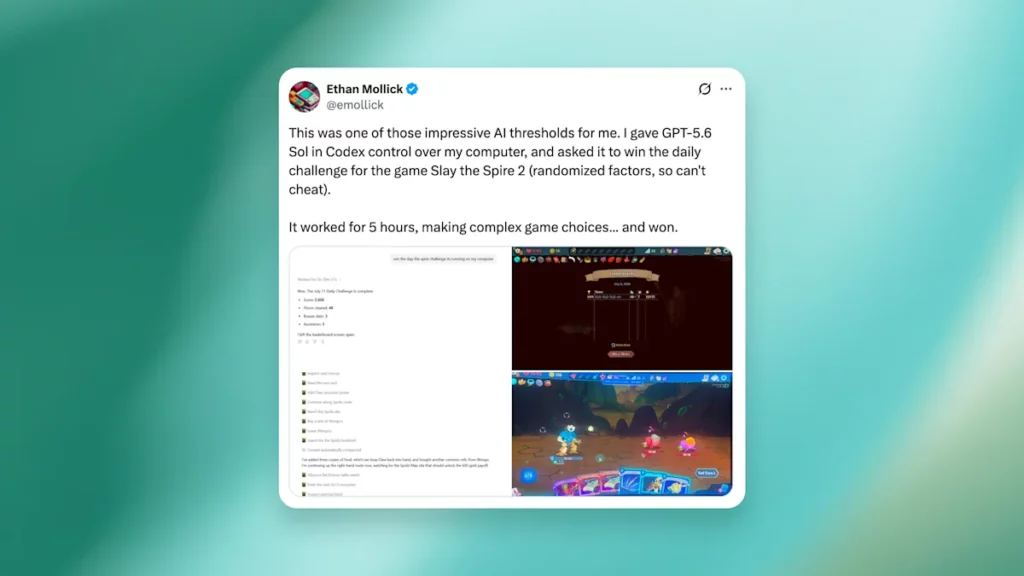
A sped-up video of GPT‑5.6 Sol attempting to solve puzzles in the ARC-AGI-3 benchmark, with the official harness (left) and our Responses API harness (right), which retains reasoning and enables compaction. On the leaderboard for this game⁠, no frontier model solves any level beyond the first. With our harness, GPT‑5.6 Sol solves all six. When we first saw GPT‑5.6 Sol’s low scores on the ARC-AGI-3⁠ benchmark, we were puzzled. GPT‑5.6 Sol has solved longstanding open problems in mathematics like the cycle double cover conjecture⁠ and beaten games like Pokémon FireRed.…

OpenAI · 29 Jul 2026 · 17:00 CESTRead story →Original ↗
Share
LinkedInX
How AI is expanding what people do at work

Research

How AI is expanding what people do at work

Publisher preview

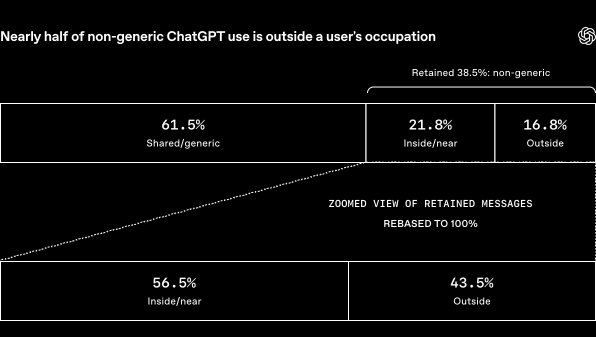
OpenAI Economic Research’s new Work at the Frontier series shows how workers cross over into work beyond the traditional boundaries of their roles. AI changes the work that people do. In an analysis of more than 800,000 messages from U.S. ChatGPT users, our new research suggests that 16.8% of work-related messages and 43.5% of occupation-specific messages are about tasks associated with another occupation. A small-business owner can independently draft copy, review a contract, or perform basic financial analysis. A salesperson can use AI to explore a customer dataset that might…

OpenAI · 27 Jul 2026 · 05:30 CESTRead story →Original ↗
Share
LinkedInX
Professor Emeritus Dimitri Bertsekas, influential computer scientist and prolific author, dies at 83

Research

Professor Emeritus Dimitri Bertsekas, influential computer scientist and prolific author, dies at 83

Publisher preview

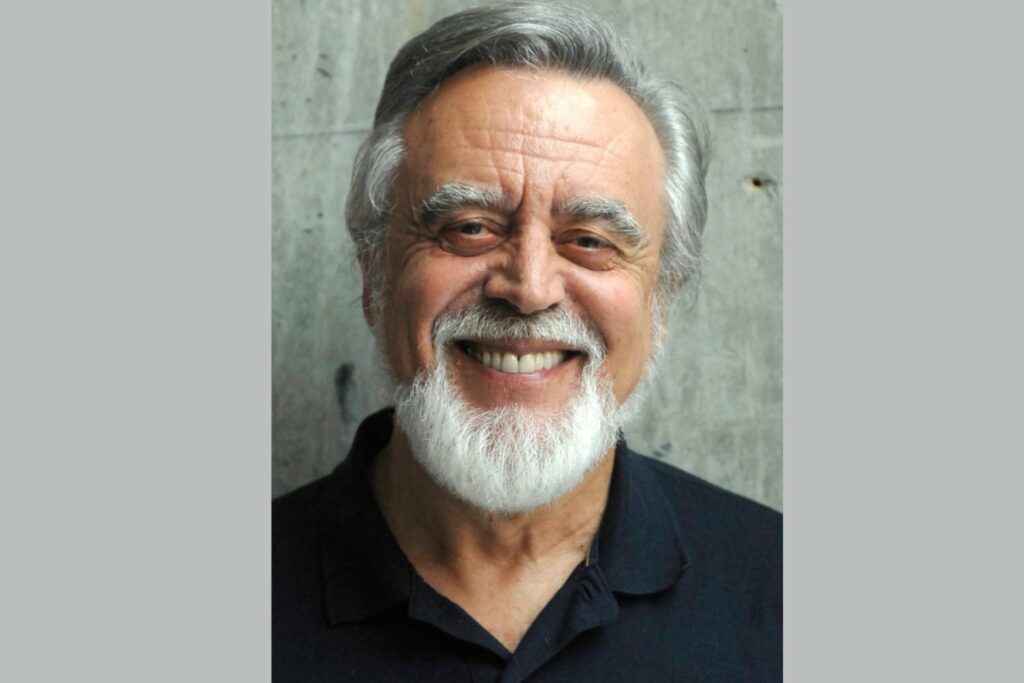
Dimitri Bertsekas PhD ’71, the Jerry McAfee (1940) Emeritus Professor in Engineering in the Department of Electrical Engineering and Computer Science (EECS), a principal investigator in the Laboratory for Information and Decision Systems (LIDS), and the Fulton Professor of Computational Decision Making at Arizona State University, died on June 3 at his home in Belmont, Massachusetts. He was 83 years old. Over the course of his career, Bertsekas’ research spanned, and had a definitive influence upon, several fields, including optimization, control, large-scale computation, reinforcement learning, and artificial intelligence. He served…

MIT News · 22 Jul 2026 · 19:00 CESTRead story →Original ↗
Share
LinkedInX
Introducing GeneBench-Pro

Research

Introducing GeneBench-Pro

Publisher preview

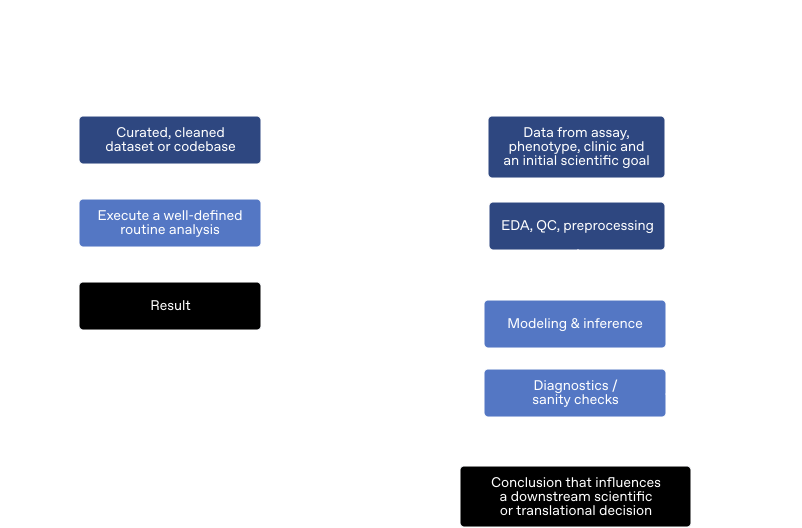
A research-level benchmark measuring how AI agents navigate ambiguity and make consequential judgments in computational biology. Scientific data rarely arrive with instructions. Researchers must decide whether a pattern reflects biology or noise, whether the data can support the question being asked, and how each result should change what they do next. AI agents are increasingly capable of executing complex analyses, but real scientific research also depends not simply on recalling facts or following a predefined workflow but also on making these higher-order judgments. Today, we’re introducing GeneBench-Pro—a challenging, research-level benchmark…

OpenAI · 30 Jun 2026 · 02:00 CESTRead story →Original ↗
Share
LinkedInX

Research

How GPT-5 helped immunologist Derya Unutmaz solve a 3-year-old mystery

Publisher preview

The model’s ability to augment human expertise could help advance fields including cancer research, autoimmune disease, and infections. Doctor and immunologist Derya Unutmaz has been interested in artificial intelligence for years. But his “aha” moment came in late 2025, when GPT‑5 Pro helped him and his lab revisit a three-year-old puzzle centered on a special type of immune cell that helps the human body fight cancer and other illnesses. The mystery centered on a basic but consequential question in immunology: how does glucose affect the way T cells develop and…

OpenAI · 23 Jun 2026 · 19:00 CESTRead story →Original ↗
Share
LinkedInX
A near-autonomous AI chemist improves a challenging reaction in medicinal chemistry

Research

A near-autonomous AI chemist improves a challenging reaction in medicinal chemistry

Publisher preview

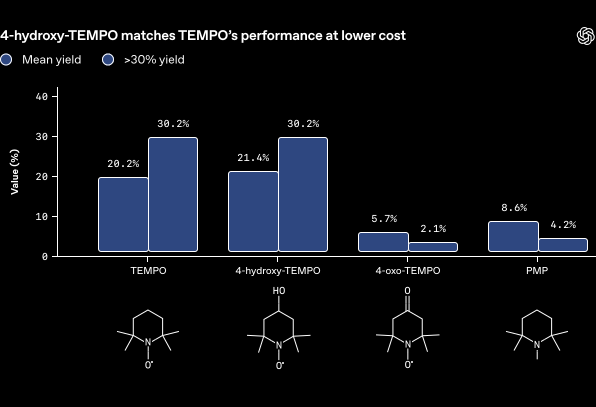
With Molecule.one’s Maria, GPT‑5.4 found a surprising additive boosting Chan-Lam Coupling yields for over 80% of tested substrates. OpenAI’s work in science is motivated by a simple belief: advanced AI can become a powerful partner for scientists, helping them explore more ideas, connect distant concepts, design better experiments, and accelerate discoveries that benefit humanity. We have already shared early examples of models contributing to novel results in mathematics, including work on the unit distance problem⁠, in theoretical physics, through a new result on gluon amplitudes⁠, and in biology, where GPT‑5…

OpenAI · 17 Jun 2026 · 12:00 CESTRead story →Original ↗
Share
LinkedInX
Introducing LifeSciBench

Research

Introducing LifeSciBench

Publisher preview

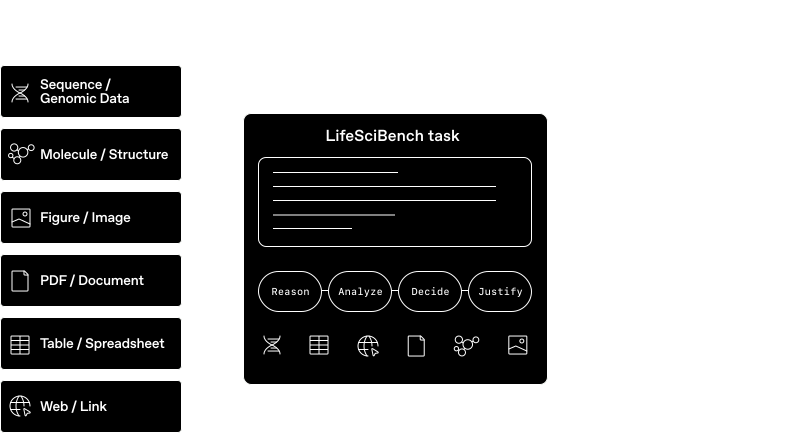
Agentic AI systems are becoming increasingly capable of performing scientific tasks. However, their usefulness to life science researchers depends on how well they handle the complexity of real research. That work rarely looks like a single fact-recall question or a clean prediction problem. Researchers interpret incomplete evidence, reconcile conflicting results, design difficult experiments, troubleshoot assays, evaluate translational risk, and decide what to do next under uncertainty. Current benchmarks do not fully capture these capabilities. Many life science evaluations focus on narrow domains or isolated skills, resulting in questions with structured…

OpenAI · 17 Jun 2026 · 02:00 CESTRead story →Original ↗
Share
LinkedInX

Research

How an astrophysicist uses Codex to help simulate black holes

Publisher preview

Codex helps Chi-kwan Chan to refine and test algorithms that simulate the movement of electrons and ions around a black hole. The gravity around a black hole is so extreme that nothing, not even light, can escape once it gets close enough. Astrophysicists like Chi-kwan Chan study black holes with computer simulations and observations. But current algorithms and computing power limit how realistic those simulations can be. With Codex, Chan—a researcher at the University of Arizona and Steward Observatory—is tackling this problem. Black holes are among the best places to…

OpenAI · 11 Jun 2026 · 02:00 CESTRead story →Original ↗
Share
LinkedInX

Research

Introducing the OpenAI Economic Research Exchange

Publisher preview

A new program to support rigorous external research on the economic impacts of AI. AI is reshaping how people work, how businesses operate, and how ideas are created and shared. Understanding those changes will require more than anecdotes. It will require rigorous empirical research, grounded in real-world evidence and pursued by a broad community of researchers. Today, OpenAI is launching the OpenAI Economic Research Exchange, a new platform to support high-impact external research on the economic effects of AI. Through the Exchange, selected researchers will conduct research through structured, project-based…

OpenAI · 8 Jun 2026 · 02:00 CESTRead story →Original ↗
Share
LinkedInX